
Plant Kingdom for NEET: Class 11 Chapter 3 Guide and Traps
Plant kingdom is Chapter 3 of NCERT Class 11 Biology, and for NEET it is the plant part of Unit 1, Diversity in Living World. It is the classification of Kingdom Plantae into algae, bryophytes, pteridophytes, gymnosperms and angiosperms, with the features and examples of each group. This guide maps plant kingdom to the NMC syllabus line by line, puts every group into tables, and lists the traps that cost marks.
What is the plant kingdom in NEET?
The plant kingdom in NEET is Kingdom Plantae as NCERT Class 11 Biology Chapter 3 classifies it: algae, bryophytes, pteridophytes, gymnosperms and angiosperms. Questions test the salient features of each group, the correct examples, the pigments and stored food of the three algal classes, and which generation dominates each life cycle.
One sentence in the chapter opening clears up an old confusion. Fungi, and members of Monera and Protista with cell walls, are no longer placed in Plantae. So cyanobacteria, also called blue green algae, are "not algae any more". That line alone settles a common trick option.
NCERT also explains why classification changed over time. Linnaeus's system was artificial, based mainly on vegetative characters or the androecium. Bentham and Hooker gave a natural system for flowering plants that also used internal features. Today, phylogenetic systems based on evolutionary relationships are accepted. Know those three names and the one-line idea behind each.
Where is plant kingdom in the NEET syllabus?
Plant kingdom sits in Biology Unit 1, Diversity in Living World, of the NMC syllabus for NEET (UG) 2026, dated 22 December 2025. Its third bullet reads: "Salient features and classification of plants into major groups: Algae, Bryophytes, Pteridophytes, Gymnosperms (three to five salient and distinguishing features and at least two examples of each category)".
| Syllabus phrase (Unit 1) | Where NCERT teaches it | What questions ask |
|---|---|---|
| Algae | Section 3.1 and Table 3.1 | Pigments, stored food, cell wall, flagella, habitat, examples, uses |
| Bryophytes | Section 3.2 (liverworts and mosses) | Haploid gametophyte, dependent sporophyte, gemmae, protonema, examples |
| Pteridophytes | Section 3.3 | Vascular tissue, prothallus, heterospory, four classes with examples |
| Gymnosperms | Section 3.4 | Naked seeds, cones, coralloid roots, mycorrhiza, pollen grain |
| Three to five features, two examples each | Whole chapter | Match the example to the group |
Notice what the bullet leaves out. Angiosperms are not one of the four named groups in Unit 1. The flowering plant is taught in depth elsewhere in the syllabus, starting with morphology of flowering plants in Unit 2. Section 3.5 of plant kingdom is short and only sets up the split into dicotyledons and monocotyledons.
The NEET (UG) 2026 information bulletin answers "Is there any change in the syllabus?" with "No". As of 9 November 2026, NTA's examination calendar lists no NEET (UG) 2027 date and no 2027 notice has appeared, so the 2026 text is the latest official version. Our NEET Biology syllabus guide shows Unit 1 next to the other nine units.
What changed in the current NCERT chapter?
The plant kingdom chapter in the 2026-27 NCERT reprint has five sections, 3.1 Algae to 3.5 Angiosperms, five figures and a summary. There is no section on life cycle patterns, so the haplontic, diplontic and haplo-diplontic labels many older notes teach are not explained anywhere in the current text.
This matters because a lot of revision material, and even AI answers, still treat "alternation of generations" as a core part of the chapter. Read the NCERT plant kingdom chapter PDF yourself and you will find the reprint stops at angiosperms.
There is one leftover. Exercise 8 still asks you to explain "diplontic", and Exercise 4 asks for the ploidy of cells such as a moss protonema or a fern prothallus. So do not throw away the idea of ploidy. The chapter text still tells you everything those exercises need:
- In bryophytes, the main plant body is haploid and is the gametophyte.
- The zygote is diploid and grows into the sporophyte, which makes haploid spores by meiosis.
- In pteridophytes the main plant body is the sporophyte; the prothallus is the gametophyte.
- In gymnosperms both gametophytes stay inside the sporangia on the sporophyte.
Our NEET deleted syllabus guide covers what else was trimmed from the NCERT books.
How are algae classified?
Algae are classified into three classes, Chlorophyceae, Phaeophyceae and Rhodophyceae, by the pigments they carry and the food they store. NCERT defines algae as chlorophyll-bearing, simple, thalloid, autotrophic and largely aquatic organisms. Learn Table 3.1 across the rows; it is the most tested table in the plant kingdom chapter.
| Class | Common name | Major pigments | Stored food | Cell wall | Flagella | Examples |
|---|---|---|---|---|---|---|
| Chlorophyceae | Green algae | Chlorophyll a, b | Starch | Cellulose | 2 to 8, equal, apical | Chlamydomonas, Volvox, Ulothrix, Spirogyra, Chara |
| Phaeophyceae | Brown algae | Chlorophyll a, c, fucoxanthin | Mannitol, laminarin | Cellulose and algin | 2, unequal, lateral | Ectocarpus, Dictyota, Laminaria, Sargassum, Fucus |
| Rhodophyceae | Red algae | Chlorophyll a, d, phycoerythrin | Floridean starch | Cellulose, pectin and poly sulphate esters | Absent | Polysiphonia, Porphyra, Gracilaria, Gelidium |
Algae reproduce in three ways. Vegetative reproduction is by fragmentation. Asexual reproduction is by spores, most often flagellated zoospores. Sexual reproduction has three types, and this is where examples get swapped:
| Type | What fuses | NCERT example |
|---|---|---|
| Isogamous | Two gametes of similar size, flagellated | Ulothrix |
| Isogamous | Two gametes of similar size, non-flagellated | Spirogyra |
| Anisogamous | Two gametes of different size | Eudorina |
| Oogamous | Large non-motile female gamete and small motile male gamete | Volvox, Fucus |
Algae are not a side topic. NCERT states that at least half of the total carbon dioxide fixation on earth is carried out by algae through photosynthesis. About 70 species of marine algae are used as food, including Porphyra, Laminaria and Sargassum. Agar comes from Gelidium and Gracilaria, algin from brown algae and carrageen from red algae. Chlorella, a protein-rich unicellular alga, is a food supplement even for space travellers. Kelps, the giant brown algae, can reach 100 metres.
Why are bryophytes called amphibians of the plant kingdom?
Bryophytes are called amphibians of the plant kingdom because they live on land, in soil, but depend on water for sexual reproduction. Their male gametes, the biflagellate antherozoids, must swim through water to reach the flask-shaped archegonium. They grow in damp, humid and shaded places and help plant succession on bare rock.
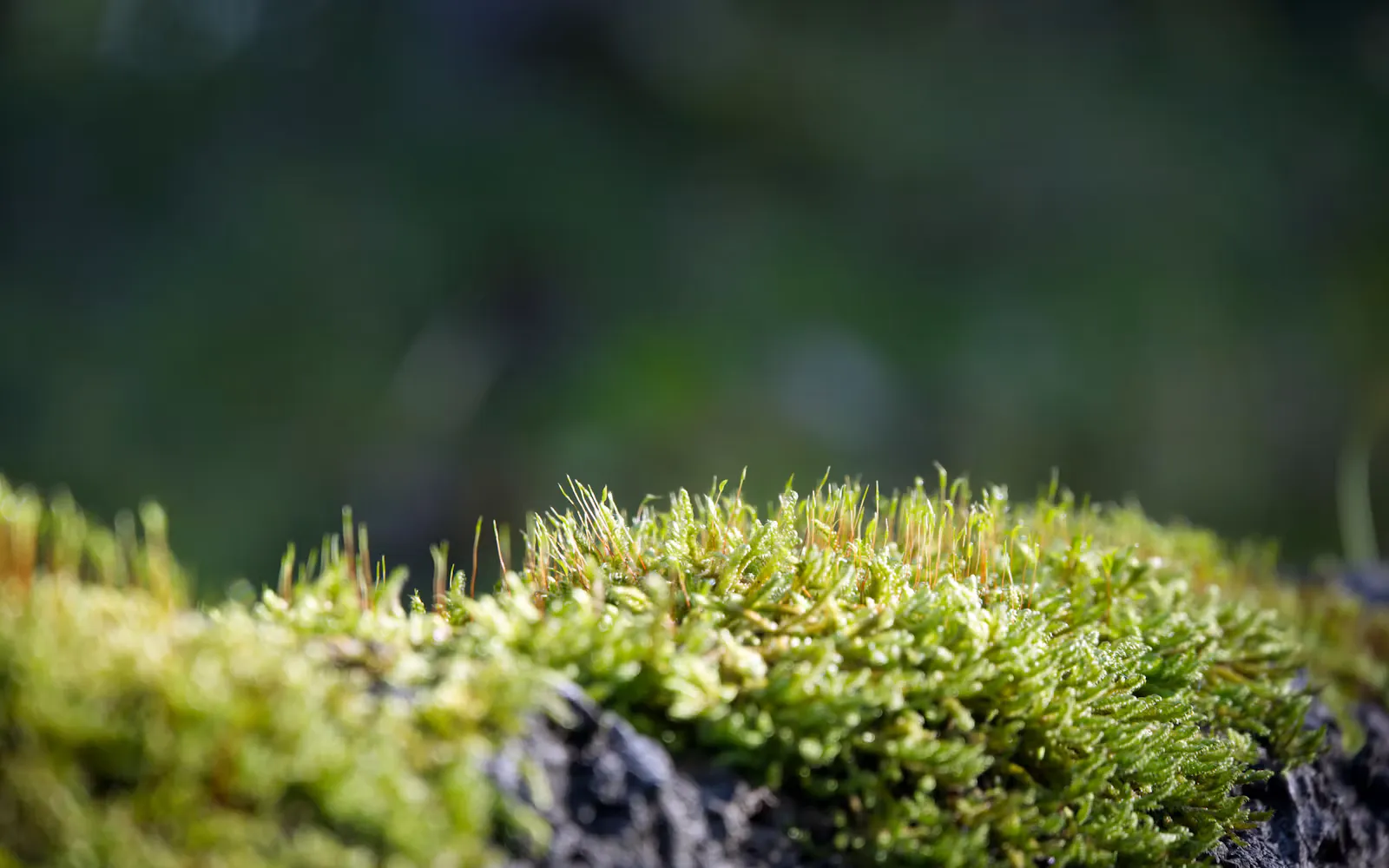
The bryophyte body has root-like, stem-like and leaf-like parts but no true roots, stem or leaves. It is attached by rhizoids. The main plant body is haploid and makes gametes, so it is the gametophyte. After fertilisation the zygote grows into a sporophyte that stays attached to the gametophyte and takes its nourishment from it. Meiosis in the sporophyte gives haploid spores.
Bryophytes split into two groups. Keep them apart:
| Feature | Liverworts | Mosses |
|---|---|---|
| Plant body | Thalloid, dorsiventral, pressed to the ground | Upright slender axes with spirally arranged leaves |
| Asexual reproduction | Fragmentation, gemmae in gemma cups | Fragmentation and budding in the secondary protonema |
| Special stage | None named | Protonema, then the leafy stage |
| Rhizoids | Present | Multicellular and branched |
| Sporophyte | Foot, seta, capsule | Foot, seta, capsule, more elaborate |
| Examples | Marchantia | Funaria, Polytrichum, Sphagnum |
Sphagnum gives peat, used as fuel and as packing material because it holds water. Mosses and lichens are the first organisms to colonise rocks.
What makes pteridophytes the first vascular plants?
Pteridophytes are the first terrestrial plants with vascular tissue, xylem and phloem. Their main plant body is a diploid sporophyte with true roots, stem and leaves. Horsetails and ferns belong here. They still need water for fertilisation, so they stay in cool, damp, shady places.
The sporophyte bears sporangia on leaf-like sporophylls. In Selaginella and Equisetum the sporophylls form compact cones called strobili. Spores grow into a small, free-living, mostly photosynthetic gametophyte called the prothallus. Leaves can be small microphylls, as in Selaginella, or large macrophylls, as in ferns.
Most pteridophytes are homosporous: all spores are alike. Selaginella and Salvinia are heterosporous, making large megaspores and small microspores. The female gametophyte stays on the parent sporophyte and the embryo starts developing inside it. NCERT calls this the precursor to the seed habit, an important step in evolution.
| Class | Examples |
|---|---|
| Psilopsida | Psilotum |
| Lycopsida | Selaginella, Lycopodium |
| Sphenopsida | Equisetum |
| Pteropsida | Dryopteris, Pteris, Adiantum |
Gymnosperms: naked seeds and two kinds of spores
Gymnosperm means naked seed. The ovules are not enclosed by an ovary wall, before or after fertilisation, so the seeds are exposed. Sequoia, the giant redwood, is one of the tallest tree species.
The features NCERT gives that questions pick up:
- Roots: tap roots. Pinus roots have a fungal association called mycorrhiza. Cycas has coralloid roots associated with nitrogen-fixing cyanobacteria.
- Stems and leaves: unbranched in Cycas, branched in Pinus and Cedrus. Needle-like leaves in conifers, with a thick cuticle and sunken stomata to cut water loss.
- Spores: gymnosperms are heterosporous. Microsporophylls form male cones, megasporophylls form female cones.
- Cones on one tree or two: Pinus bears male and female cones on the same tree. In Cycas, male cones and megasporophylls are on different trees.
- Gametophytes: not free-living. The male gametophyte is reduced to the pollen grain. The female gametophyte has two or more archegonia and stays inside the megasporangium.
- Fertilisation: wind carries pollen to the ovule. The pollen tube carries the male gametes to the archegonia, so no free water is needed.
Angiosperms, section 3.5, differ in one key way: pollen grains and ovules develop in flowers, and seeds are enclosed in fruits. They range from the tiny Wolffia to Eucalyptus over 100 metres tall, and split into dicotyledons and monocotyledons.
Plant kingdom groups side by side
Most plant kingdom questions are comparisons, so this one table does the most work. Every cell comes from the NCERT chapter text.
| Feature | Algae | Bryophytes | Pteridophytes | Gymnosperms |
|---|---|---|---|---|
| Body | Thalloid | Thallus-like, rhizoids, no true organs | True root, stem, leaves | Trees and shrubs, tap roots |
| Dominant phase | Not covered in the current text | Haploid gametophyte | Diploid sporophyte | Diploid sporophyte |
| Vascular tissue | No | No | Yes, first group to have it | Yes |
| Water for fertilisation | Yes, mostly aquatic | Yes | Yes | No, pollen tube |
| Free-living gametophyte | Not applicable | Yes, it is the main plant | Yes, the prothallus | No |
| Seeds | No | No | No | Yes, naked |
| Two examples | Volvox, Fucus | Marchantia, Funaria | Selaginella, Dryopteris | Cycas, Pinus |
How many plant species does India have?
India has 22,368 documented angiosperms, 9,117 algae, 2,850 bryophytes, 1,325 pteridophytes and just 83 gymnosperms, according to the Botanical Survey of India annual report 2024-25. The same report counts 56,177 documented floristic elements in all, a figure that also includes fungi and lichens.
These are survey counts for India in one reporting year, not exam facts, and they grow as new taxa are published: the 2023-24 report gave 22,108 angiosperms. Use them for perspective. Gymnosperms are a small group, which is why the same few genera, Cycas, Pinus, Cedrus and Ginkgo, keep appearing in questions.
Ten traps in plant kingdom questions
These are the swaps that turn a known fact into a wrong answer. Each one comes straight from the plant kingdom chapter text.
- Blue green algae are not algae. Cyanobacteria were moved out of Plantae.
- Spirogyra is isogamous. Its gametes are non-flagellated but similar in size. Do not mark it anisogamous.
- Red algae have no flagella. Green algae have 2 to 8 equal apical flagella; brown algae have 2 unequal lateral ones.
- Floridean starch belongs to red algae. Mannitol and laminarin belong to brown algae.
- Fucoxanthin means brown. Phycoerythrin means red. Chlorophyll b means green.
- The bryophyte plant you see is haploid. Its sporophyte is dependent, not free-living.
- Gemmae belong to liverworts, protonema to mosses. Marchantia has gemma cups; Funaria has a protonema stage.
- Selaginella and Salvinia are heterosporous. Most other pteridophytes are homosporous.
- Coralloid roots are Cycas; mycorrhiza is Pinus. Coralloid roots hold nitrogen-fixing cyanobacteria.
- Agar is from red algae. Gelidium and Gracilaria give agar; algin is from brown algae.
Every wrong answer costs a mark under NEET's plus four, minus one scheme, and Biology carries 90 of the 180 questions and 360 of the 720 marks in the 2026 bulletin. NTA does not publish chapter-wise question counts, so treat any exact number you see online as an estimate. Our page on negative marking in NEET explains when a guess is worth it.
A four-day revision plan
Plant kingdom is short enough to finish in four sittings of about an hour. Do it in this order.
- Day 1: Read section 3.1. Redraw Table 3.1 from memory, then the sexual reproduction table with its four examples.
- Day 2: Sections 3.2 and 3.3. Write the liverwort vs moss table and the four pteridophyte classes with examples.
- Day 3: Sections 3.4 and 3.5. List the gymnosperm features, then fill the side-by-side comparison table without looking.
- Day 4: Answer NCERT Exercises 1 to 11, then a timed set of 30 mixed plant kingdom questions at under a minute each. Log each wrong answer by type: pigment, example, ploidy or feature.
Figures 3.1 to 3.5 show the specimens; our NEET Biology diagrams guide explains how much attention they need. Once plant kingdom is done, the next chapter in Unit 1 is animal kingdom for NEET, and a steady set of NEET Biology MCQ practice keeps both fresh.
For your wider plan, the NEET 2027 chapter-wise weightage guide on futureMBBS shows how big Diversity in Living World is next to the other Biology units. Its NEET syllabus overview puts all ten Biology units on one page, and its explainer what is an NCERT book is useful if you are deciding how far beyond the textbook to read.
If plant kingdom is where easy Botany marks keep slipping, NEETsheet's chapter-wise practice and timed mocks show whether the gap is the algae table, the examples or the life cycle facts, so your next hour goes to the right place. Start at neetsheet.in.
Sources
All links were checked on 9 November 2026.
- National Medical Commission (UGMEB), Syllabus for NEET (UG) 2026, public notice of 22 December 2025 (Biology Unit 1, Diversity in Living World: algae, bryophytes, pteridophytes and gymnosperms, three to five features and two examples each; Unit 2 morphology of flowering plants): https://cdnbbsr.s3waas.gov.in/s37bc1ec1d9c3426357e69acd5bf320061/uploads/2026/01/202601081066816297.pdf
- National Testing Agency, Information Bulletin NEET (UG) 2026 (pattern: Biology 90 questions and 360 of 720 marks; plus four and minus one marking; syllabus FAQ "no change"): https://cdnbbsr.s3waas.gov.in/s37bc1ec1d9c3426357e69acd5bf320061/uploads/2026/02/202602231394640855.pdf
- National Testing Agency, Examination Calendar December 2026 cycle onwards (no NEET (UG) 2027 date listed): https://nta.ac.in/Download/Notice/ExamcalendarRevised.pdf
- NCERT, Biology Class 11, Chapter 3 Plant Kingdom, reprint 2026-27 (sections 3.1 to 3.5, Table 3.1, Figures 3.1 to 3.5, Summary and Exercises): https://ncert.nic.in/textbook/pdf/kebo103.pdf
- Botanical Survey of India, Annual Report 2024-25 (56,177 documented floristic elements in India, including 22,368 angiosperms, 83 gymnosperms, 1,325 pteridophytes, 9,117 algae and 2,850 bryophytes): https://bsi.gov.in/uploads/documents/reports/annualReportBsi/hindi/Annual_Report-2024-2025_final.pdf
- Botanical Survey of India, Annual Report 2023-24 (55,387 taxa, including 22,108 angiosperms): https://bsi.gov.in/uploads/documents/reports/annualReportBsi/english/BSI_Annual_Report_2023-2024.pdf
Frequently Asked Questions
Plant kingdom is Chapter 3 of NCERT Class 11 Biology. It classifies Kingdom Plantae into algae, bryophytes, pteridophytes, gymnosperms and angiosperms, with the salient features and examples of each group. In NEET it is the plant part of Biology Unit 1, Diversity in Living World.
Plant kingdom is a Class 11 chapter. It is Chapter 3 of NCERT Class 11 Biology, between Biological Classification and Animal Kingdom. In the NMC syllabus for NEET (UG) 2026 it sits in Biology Unit 1, Diversity in Living World.
Bryophytes are called amphibians of the plant kingdom because they live in soil but depend on water for sexual reproduction. Their antherozoids swim through water to reach the archegonium. They grow in damp, humid and shaded places, like liverworts such as Marchantia and mosses such as Funaria.
Gymnosperms have naked seeds: their ovules are not enclosed by an ovary wall, so seeds stay exposed, as in Cycas and Pinus. In angiosperms, pollen grains and ovules develop in flowers and the seeds are enclosed in fruits. Angiosperms divide into dicotyledons and monocotyledons.
Yes. The NMC syllabus names four of its groups and asks for three to five features and two examples of each, which suits short factual questions. NTA does not publish chapter-wise question counts, so no exact number is official. Biology as a whole carries 90 questions and 360 of the 720 marks.