
Thermodynamics for NEET: Physics and Chemistry in One Guide
Thermodynamics is the study of how heat, work and internal energy change when a system moves from one state to another, and of which changes can happen on their own. In the NEET (UG) syllabus it appears twice: Physics Unit 8, Thermodynamics, and Chemistry Unit 4, Chemical Thermodynamics. The two units share one first law but write it with opposite sign rules for work. This guide puts thermodynamics for NEET from both subjects on one page, works the NCERT numbers, and shows how to switch conventions without dropping a sign.
Where does thermodynamics appear in the NEET syllabus?
Thermodynamics appears in two places in the syllabus: Physics Unit 8 and Chemistry Unit 4. The NMC syllabus for NEET (UG) 2026, issued by the Undergraduate Medical Education Board on 22 December 2025, prints three lines for the Physics unit and a longer block for the Chemistry unit. Here is what each phrase asks of you.
| Unit | Syllabus phrase | What you should be able to do |
|---|---|---|
| Physics 8 | Thermal equilibrium, zeroth law, concept of temperature | Explain why two bodies each in equilibrium with a third share a temperature |
| Physics 8 | Heat, work and internal energy; first law | Use ΔQ = ΔU + ΔW with W done by the gas |
| Physics 8 | Isothermal and adiabatic processes | Use PV = constant and PV^γ = constant, and the work formula for each |
| Physics 8 | Second law: reversible and irreversible processes | State the Kelvin-Planck and Clausius forms and spot an irreversible process |
| Chemistry 4 | System and surroundings, extensive and intensive properties, state functions, types of processes | Classify a property and say whether it depends on the path |
| Chemistry 4 | First law: work, heat, internal energy, enthalpy, heat capacity, molar heat capacity | Use ΔU = q + w and ΔH = ΔU + ΔngRT |
| Chemistry 4 | Hess's law; enthalpies of bond dissociation, combustion, formation, atomization, sublimation, phase transition, hydration, ionization and solution | Add and reverse equations to find an unknown enthalpy |
| Chemistry 4 | Second law: spontaneity, ΔS of the universe and ΔG of the system; ΔG° and equilibrium constant | Predict spontaneity from the signs of ΔH and ΔS, and link ΔG° to K |
Two neighbours sit just outside these units. Specific heat capacity, calorimetry and latent heat are printed in Physics Unit 7, Properties of Solids and Liquids. The kinetic theory of gases, including the specific heat capacities of gases, is Physics Unit 9. Chemical kinetics, which tells you how fast a reaction runs, is Chemistry Unit 8.
How many marks can thermodynamics decide?
Thermodynamics can decide marks in two sections of the paper, because Physics and Chemistry each test it. The NEET (UG) 2026 information bulletin fixes Physics at 45 questions and 180 of the 720 marks, Chemistry at another 45 questions and 180 marks, in a 180 minute paper. NTA does not publish how many questions come from each unit, so any exact chapter count you read online is an estimate.
The marking rewards accuracy. A right answer earns plus four, a wrong one costs minus one, and a blank is zero. A sign error in a first law question is exactly the kind of slip that turns plus four into minus one, so read our guide to negative marking in NEET before you start timed practice.
What is the first law of thermodynamics?
The first law of thermodynamics is the law of conservation of energy for a system that exchanges heat and work with its surroundings. The heat you supply is shared between raising the internal energy and doing work. Internal energy, U, is a state function: its change depends only on the start and end states. Heat and work are not; they depend on the path.
NCERT Physics Class 11 Part II, Chapter 11 Thermodynamics (reprint 2026-27), states it as ΔQ = ΔU + ΔW, where ΔQ is heat supplied to the system and ΔW is work done by the system. NCERT Chemistry Class 11 Part I, Unit 5 Thermodynamics (reprint 2026-27), states it as ΔU = q + w, where q is heat given to the system and w is work done on it.
NASA's Glenn Research Center writes the same law in the engineering form E2 - E1 = Q - W, with W done by the system, which is the Physics convention again.
Why do physics and chemistry write the first law differently?
Physics and chemistry write the first law differently because they count work from opposite sides. NCERT Chemistry says so itself in a footnote to Unit 5: the old convention, positive work when done by the system, "is still followed in physics books, although IUPAC has recommended the use of new sign convention." The physics is identical; only the sign of w flips.
| Quantity | NCERT Physics (Unit 8) | NCERT Chemistry (Unit 4) |
|---|---|---|
| First law | ΔQ = ΔU + ΔW | ΔU = q + w |
| Heat absorbed by the system | ΔQ positive | q positive |
| Gas expands (does work) | ΔW positive | w negative |
| Gas is compressed | ΔW negative | w positive |
| Work at constant external pressure | ΔW = P ΔV | w = -pex ΔV |
| Reversible isothermal work, ideal gas | W = µRT ln(V2/V1) | w = -2.303 nRT log(Vf/Vi) |
A quick test shows the answer does not change. Chemistry Exercise 5.7 has 701 J of heat absorbed and 394 J of work done by the system. Chemistry: w = -394 J, so ΔU = 701 + (-394) = 307 J. Physics: ΔU = ΔQ - ΔW = 701 - 394 = 307 J. Same ΔU, two bookkeeping styles. Physics Exercise 11.7 is the same idea per second: a 100 W heater and 75 J/s of work done by the system leave internal energy rising at 25 W.
The safe habit is one sentence before every first law question: "Is this W done by the gas or on it?" Answer that, write the matching form, and the sign looks after itself.
One pot of boiling water, worked in both books
Both NCERT books happen to boil water at atmospheric pressure, which makes the cleanest side-by-side test of the two conventions you will find.
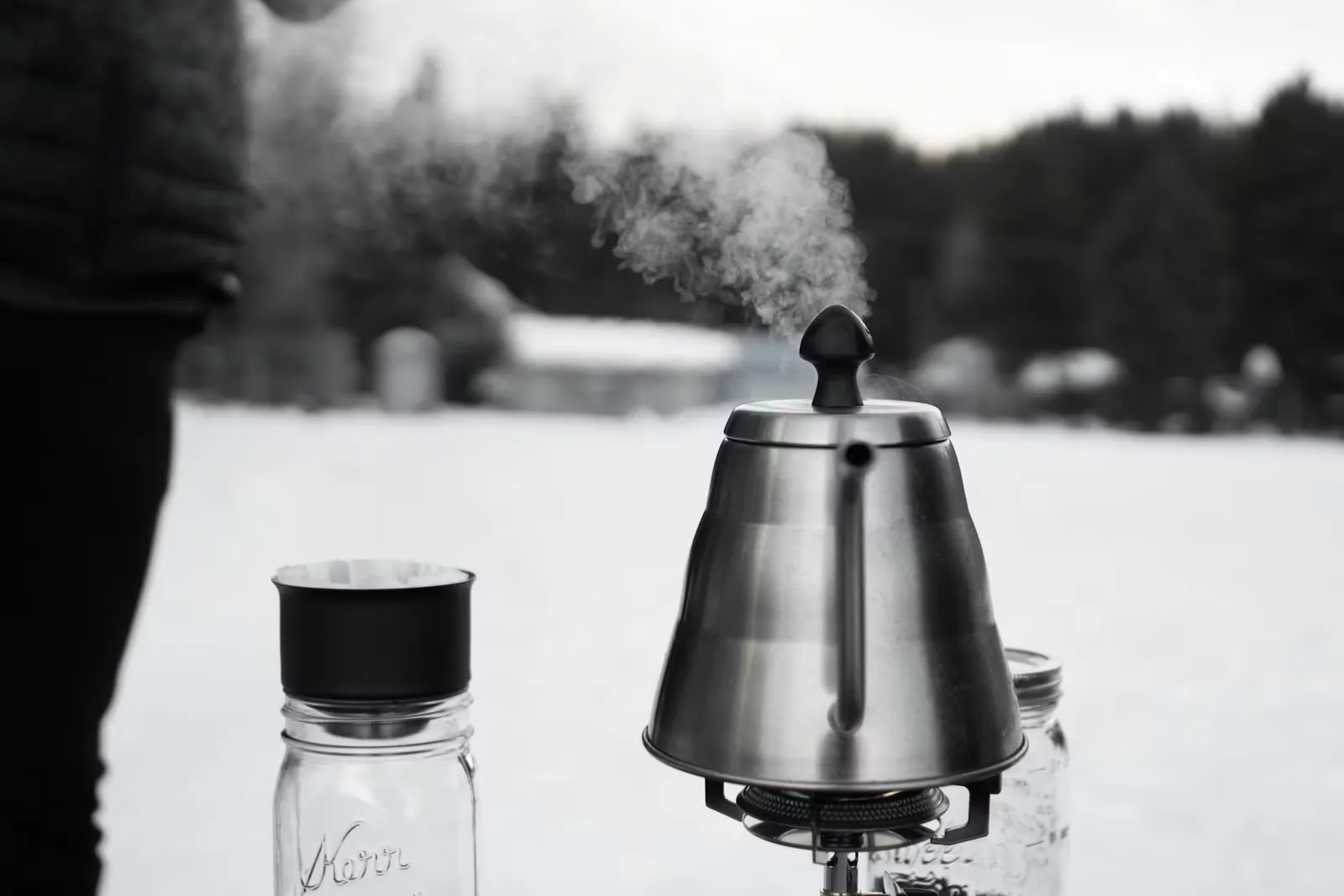
Physics works per gram. The latent heat of water is 2256 J/g, so ΔQ = 2256 J. One gram of water fills 1 cm³ as liquid and 1671 cm³ as vapour, so the work done by the steam against the atmosphere is ΔW = 1.013 × 10⁵ × (1671 × 10⁻⁶) = 169.2 J. Then ΔU = 2256 - 169.2 = 2086.8 J.
Chemistry works per mole. Problem 5.5 takes the molar enthalpy of vaporisation at 1 bar and 100 °C as 41 kJ/mol. One mole of gas forms, so Δng = 1 and ΔU = ΔH - ΔngRT = 41.00 - (1 × 8.3 × 373)/1000 = 41.00 - 3.096 = 37.904 kJ/mol.
The two books use different amounts, different units and different signs, yet land on the same split. That is the point to carry into the exam: if your two answers to one physical process disagree, the mistake is in a sign, not in the physics.
Isothermal and adiabatic processes: the formulas you need
Isothermal means constant temperature; adiabatic means no heat exchange. For an ideal gas, internal energy depends only on temperature, so in an isothermal process ΔU = 0 and the heat absorbed equals the work done by the gas. In an adiabatic process Q = 0, so any work done by the gas comes straight out of its internal energy and it cools.
| Process | What stays fixed | Key relation (NCERT Physics) | First law becomes |
|---|---|---|---|
| Isothermal | T | PV = constant; W = µRT ln(V2/V1) | ΔU = 0, so Q = W |
| Adiabatic | No heat flow | PV^γ = constant; W = µR(T1 - T2)/(γ - 1) | Q = 0, so ΔU = -W |
| Isochoric | V | No work, W = 0 | Q = ΔU |
| Isobaric | P | W = P(V2 - V1) | Q = ΔU + PΔV |
Chemistry's Problems 5.2 to 5.4 show why work is a path function. The same expansion from 2 L to 10 L at 25 °C gives zero work into a vacuum (free expansion), 8 L atm against a constant 1 atm, and 39.366 L atm when done reversibly (Problem 5.4 works it for 1 mol). One start, one finish, three different amounts of work.
Physics Exercise 11.4 is the standard adiabatic test: 3 moles of hydrogen in an insulated cylinder squeezed to half the volume. From PV^γ = constant, the pressure rises by a factor of 2^γ. With γ = 1.4 for a diatomic gas, that is about 2.64 (our arithmetic), more than the factor of 2 you would get isothermally. The adiabatic curve on a P-V graph is steeper for the same reason.
For a quick list of every formula in all 20 Physics units, with the conditions under which each one holds, keep our NEET Physics formula sheet open next to this page.
What is the second law of thermodynamics?
The second law of thermodynamics tells you which energy-conserving processes can actually happen. NCERT Physics gives two equivalent statements. Kelvin-Planck: no process can have as its sole result the absorption of heat from a reservoir and its complete conversion into work. Clausius: no process can have as its sole result the transfer of heat from a colder object to a hotter one.
Chemistry states the same law through entropy: in an isolated system, the total entropy change of a spontaneous process is positive, ΔStotal = ΔSsys + ΔSsurr > 0. Divide through and you reach the Gibbs condition, ΔG = ΔH - TΔS < 0, which is the form Chemistry Unit 4 actually tests.
A reversible process, in both books, is an idealised one that can be run backwards so that system and surroundings both return to their original states. It must be quasi-static and free of friction or viscosity. Every real, spontaneous process is irreversible.
Is the Carnot engine in the NEET syllabus?
The Carnot engine is not named in the NEET (UG) 2026 syllabus. Physics Unit 8 ends with "the second law of thermodynamics: reversible and irreversible processes", and the words Carnot, heat engine and refrigerator appear nowhere in the 2026 syllabus document. NCERT Physics still teaches the Carnot engine in section 11.11, with its efficiency η = 1 - T2/T1.
So what do you do with it? Read section 11.11 once, because the Carnot cycle is the clearest picture of why reversible engines set the upper limit the second law describes. Then spend your problem practice on the processes the syllabus does name. And check again when the NEET (UG) 2027 syllabus appears, since this is an absence in the printed text, not a written exclusion. Our page on the NEET 2027 deleted syllabus lists the topics that were removed from the NEET syllabus.
Enthalpy, Hess's law and Gibbs energy in Chemistry Unit 4
Enthalpy, H, is the heat absorbed at constant pressure, and most reactions you meet run in open flasks at constant pressure. That is why Chemistry works in ΔH rather than ΔU. The link between them is ΔH = ΔU + ΔngRT, where Δng counts only gas moles (products minus reactants). Solids and liquids barely change volume, so they drop out.
ΔH is negative for exothermic reactions and positive for endothermic ones. Hess's law says the total enthalpy change is the same whether a reaction runs in one step or several, so you can add, reverse and scale known equations to reach an unknown one. Reverse an equation and the sign of ΔH flips.
Gibbs energy turns the second law into a single test, ΔG = ΔH - TΔS. NCERT's Table 5.4 is worth learning as a grid:
| ΔH | ΔS | ΔG | When is the reaction spontaneous? |
|---|---|---|---|
| Negative | Positive | Negative | At all temperatures |
| Negative | Negative | Negative at low T, positive at high T | Only at low temperature |
| Positive | Positive | Positive at low T, negative at high T | Only at high temperature |
| Positive | Negative | Positive | At no temperature |
The last line of Unit 4 connects to equilibrium: ΔG° = -RT ln K = -2.303 RT log K. NCERT's Problem 5.12 shows how extreme this gets. Turning oxygen into ozone at 298 K has Kp = 2.47 × 10⁻²⁹, which gives ΔG° = +163 kJ/mol, so ozone does not form on its own. Problem 5.13 runs the other way: ΔG° = -13.6 kJ/mol gives K = 2.4 × 10². Our guide to chemical equilibrium for NEET picks up the story from K onwards.
Seven traps in thermodynamics questions
- Mixing conventions mid-question. A Chemistry question uses w on the system; a Physics question uses W by the gas. Decide which one you are in before you write a single number.
- Forgetting that an ideal gas's U depends only on T. Any isothermal process of an ideal gas has ΔU = 0, whatever the pressure and volume do.
- Treating free expansion as adiabatic cooling. Gas rushing into a vacuum does no work and, when insulated, absorbs no heat, so ΔU = 0 and an ideal gas's temperature does not change. Physics Exercise 11.6 is built on exactly this setup.
- Using PV = constant for an adiabatic process. Adiabatic is PV^γ = constant. If the question says insulated, sand-covered piston or sudden change, think γ.
- Counting liquids in Δng. Only gas moles enter ΔH = ΔU + ΔngRT. If Δng = 0, then ΔH = ΔU.
- Reading "spontaneous" as "fast". NCERT defines spontaneity as the potential to proceed without outside help. Speed belongs to [chemical kinetics](/blogs/chemical-kinetics-for-neet/), a separate unit.
- Forgetting units in RT. R is 8.314 J mol⁻¹ K⁻¹ in energy problems but 0.08206 L atm mol⁻¹ K⁻¹ in NCERT's gas-work problems. Match R to the units of your answer, and convert J to kJ before comparing with ΔH.
A 7-day revision plan for thermodynamics
Thermodynamics is small enough to revise in a week if you treat the two subjects as one topic. This plan assumes about an hour a day.
- Day 1: Read Physics sections 11.1 to 11.5. Write the first law in both forms on one card, with the sign of work beside each.
- Day 2: Physics sections 11.6 to 11.8. Derive the isothermal work formula yourself and solve Exercises 11.4, 11.5 and 11.7.
- Day 3: Physics sections 11.9 to 11.11. Learn the Kelvin-Planck and Clausius statements word for word; read the Carnot section once.
- Day 4: Chemistry Unit 5 up to enthalpy. Solve Problems 5.1 to 5.5 and rewrite the boiling water example in the Physics convention.
- Day 5: Hess's law and the enthalpy types. Make a one-page table of the nine enthalpies named in the syllabus, each with one NCERT example.
- Day 6: Entropy and Gibbs energy. Learn Table 5.4 as a grid and solve Problems 5.12 to 5.14 and Exercises 5.16 to 5.22.
- Day 7: A mixed set of 30 questions, 15 from each subject, timed at about one minute each. Log every sign error separately from every concept error.
Once the week is done, fold thermodynamics into your wider plan. The NEET 2027 chapter-wise weightage guide on futureMBBS helps you decide where this topic sits in your revision order, and its NEET syllabus overview lists every Physics and Chemistry unit on one page. When you move to full papers, the time management guide for the NEET exam shows how to pace the Physics and Chemistry sections. For the bigger picture of each subject, see NEET Physics questions and NEET Chemistry questions.
If thermodynamics is where your Physics or Chemistry marks slip, NEETsheet's chapter-wise practice and timed mocks show whether it is the concept or the sign, so the next revision goes to the right place. Start at neetsheet.in.
Sources
All links were checked on 6 November 2026.
- National Medical Commission (UGMEB), Syllabus for NEET (UG) 2026, public notice of 22 December 2025 (Physics Units 7, 8 and 9; Chemistry Units 4 and 8): https://cdnbbsr.s3waas.gov.in/s37bc1ec1d9c3426357e69acd5bf320061/uploads/2026/01/202601081066816297.pdf
- National Testing Agency, Information Bulletin NEET (UG) 2026 (pattern: Physics and Chemistry 45 questions and 180 marks each of 720; plus four and minus one marking; 180 minutes; syllabus FAQ): https://cdnbbsr.s3waas.gov.in/s37bc1ec1d9c3426357e69acd5bf320061/uploads/2026/02/202602231394640855.pdf
- National Testing Agency, NEET (UG) website, checked on 6 November 2026 for any NEET (UG) 2027 notice: https://neet.nta.nic.in/
- National Testing Agency, Examination Calendar, December 2026 cycle onwards (no NEET (UG) 2027 date listed up to April 2027): https://nta.ac.in/Download/Notice/ExamcalendarRevised.pdf
- NCERT, Physics Class 11 Part II, Chapter 11 Thermodynamics, reprint 2026-27 (sections 11.1 to 11.11; Summary; Exercises 11.1 to 11.8): https://ncert.nic.in/textbook/pdf/keph204.pdf
- NCERT, Chemistry Class 11 Part I, Unit 5 Thermodynamics, reprint 2026-27 (sign convention footnote; Problems 5.1 to 5.14; Table 5.4; Exercises 5.1 to 5.22): https://ncert.nic.in/textbook/pdf/kech105.pdf
- NASA Glenn Research Center, First Law of Thermodynamics (Beginners Guide to Aeronautics): https://www1.grc.nasa.gov/beginners-guide-to-aeronautics/first-law-internal-energy/
Frequently Asked Questions
Thermodynamics is the branch of science that studies heat, work and internal energy, and the rules for how a system changes from one state to another. It deals with large-scale quantities such as pressure, volume and temperature. For NEET it is Physics Unit 8 and Chemistry Unit 4 of the NMC syllabus for NEET (UG) 2026.
The first law of thermodynamics is conservation of energy for a system: heat supplied equals the rise in internal energy plus the work done. NCERT Physics writes it as ΔQ = ΔU + ΔW, with W done by the system. NCERT Chemistry writes ΔU = q + w, with w done on the system, following IUPAC.
Thermodynamics is in both. Physics Unit 8 covers the zeroth, first and second laws, with isothermal and adiabatic processes. Chemistry Unit 4, Chemical Thermodynamics, covers enthalpy, Hess's law, entropy and Gibbs energy. The NCERT sources are Physics Class 11 Chapter 11 and Chemistry Class 11 Unit 5.
The Carnot engine is not named in the NMC syllabus for NEET (UG) 2026. Physics Unit 8 ends at the second law with reversible and irreversible processes, though NCERT still teaches the Carnot engine in section 11.11. Read it once for understanding, practise the named processes, and recheck when the 2027 syllabus appears.
The zeroth law says two systems each in thermal equilibrium with a third are in equilibrium with each other, which defines temperature. The first law is energy conservation, ΔU = q + w in Chemistry. The second law says spontaneous processes increase total entropy. NCERT Chemistry also states a third law: the entropy of a pure crystalline substance approaches zero as the temperature approaches absolute zero.