
Electromagnetic Induction for NEET: Laws, Formulas, Traps
Electromagnetic induction is the production of an emf, and so a current in a closed circuit, by a changing magnetic flux. In the NEET (UG) Physics syllabus it is the first half of Unit 14, "Electromagnetic Induction and Alternating Currents", and it covers Faraday's law, Lenz's law, eddy currents, self and mutual inductance, AC circuits, the AC generator and the transformer. This guide takes electromagnetic induction for NEET phrase by phrase, gives every formula with the condition under which it holds, works the NCERT examples with real numbers and ends with a revision plan you can start this week.
What does Unit 14 of the NEET syllabus ask?
Unit 14 asks for exactly the phrases printed in the syllabus, and nothing beyond them. The NMC syllabus for NEET (UG) 2026, released by the Undergraduate Medical Education Board on 22 December 2025, gives the unit four printed lines. Split into phrases, this is what each one expects from you.
| Syllabus phrase (Unit 14) | What you should be able to do |
|---|---|
| Electromagnetic induction: Faraday's law | Use ε = -N dΦ/dt and Φ = BA cos θ |
| Induced emf and current: Lenz's law | Find the direction of an induced current in any loop |
| Eddy currents | Explain them and how a laminated core reduces them |
| Self and mutual inductance | Use ε = -L dI/dt, ε1 = -M dI2/dt and L = μ0n²Al |
| Alternating currents, peak and RMS value | Use I = im/√2 and V = vm/√2 |
| Reactance and impedance | Use XL = ωL, XC = 1/ωC and Z = √(R² + (XC - XL)²) |
| LCR series circuit, resonance | Use ω0 = 1/√(LC) and know Z = R at resonance |
| Power in AC circuits, wattless current | Use P = VI cos φ and explain why cos φ = 0 means no power |
| AC generator and transformer | Use ε = NBAω sin ωt and Vs/Vp = Ns/Np |
Unit 20 of the same syllabus, Experimental Skills, lists 18 Physics experiments. None of them is about induction or AC circuits, so Unit 14 is tested on theory and numericals only.
Is electromagnetic induction still in NEET 2027? As far as anyone can say today, yes. The NEET (UG) 2026 Information Bulletin answers its own FAQ with "there is no change in the syllabus of NEET (UG) 2026 with respect to the previous year", and the NEET public notices page showed no 2027 notice when we checked on 3 November 2026. If the 2027 syllabus moves anything in Unit 14, our NEET 2027 deleted syllabus guide is where we will flag it first.
How many marks can electromagnetic induction decide?
Nobody can give you an official number, and anyone who does is guessing. The bulletin fixes the paper, not the chapter split: Physics has 45 questions worth 180 of the 720 marks, every right answer earns plus four, every wrong answer costs one, and a blank scores zero.
What that tells you is still useful. A single Physics question is worth 4 marks, and a wrong answer puts you 5 marks behind a right one. Electromagnetic induction questions are short calculations or direction questions that either work or don't, so accuracy pays and blind guessing hurts. Our NEET negative marking guide shows when a guess is worth the risk, and the NEET Physics questions guide explains how all 45 questions are marked.
Which NCERT chapters cover Unit 14?
Unit 14 sits across two chapters of NCERT Physics Class 12 Part I, reprint 2026-27: Chapter 6, Electromagnetic Induction, and Chapter 7, Alternating Current. So when someone asks whether electromagnetic induction is Class 11 or Class 12, the answer is Class 12, and it comes straight after the chapters on moving charges and magnetism.
| NCERT section | What it covers | Syllabus phrase |
|---|---|---|
| 6.2 to 6.4 | Faraday and Henry experiments, magnetic flux, Faraday's law | Faraday's law |
| 6.5 | Lenz's law and conservation of energy | Lenz's law |
| 6.6 | Motional emf, rotating rod | Induced emf and current |
| 6.7 | Mutual and self inductance, energy 1/2 LI² | Self and mutual inductance |
| 6.8 | AC generator | AC generator |
| 7.2 to 7.5 | AC through R, L and C; rms values; reactance | Peak and RMS value, reactance |
| 7.6 | Series LCR circuit, phasors, resonance | Impedance, LCR, resonance |
| 7.7 | Power factor, wattless current | Power in AC circuits |
| 7.8 | Transformer and its energy losses, eddy currents included | Transformer, eddy currents |
Here is the trap that catches toppers too. The syllabus line says "Eddy currents", but the 2026-27 Chapter 6 has no eddy current section at all. The only place NCERT explains them is one paragraph in the transformer section of Chapter 7, as a cause of heating in the iron core that a laminated core reduces. Learn that paragraph, and learn the idea behind it from Faraday's law, because the syllabus still names it.
What is Faraday's law of electromagnetic induction?
Faraday's law of electromagnetic induction says that the magnitude of the induced emf in a circuit equals the time rate of change of magnetic flux through it. For a coil of N closely wound turns, ε = -N dΦ/dt. NCERT calls the minus sign Lenz's law at work. A flux that does not change, however large, induces nothing.
Flux comes first. For a flat area A in a uniform field B, Φ = BA cos θ, where θ is the angle between the field and the area vector (the normal to the surface). Its SI unit is the weber, 1 Wb = 1 T m², and it is a scalar. That gives you three ways to change flux, and so three ways to get electromagnetic induction:
- Change B, by moving a magnet or switching a nearby current on or off.
- Change A, by sliding a rod along rails or squashing a loop.
- Change θ, by rotating a coil in a field, which is how a generator works.
NCERT's Example 6.2 is a good first numerical. A square loop of side 10 cm and resistance 0.5 Ω sits at 45° to a 0.10 T field, and the field falls to zero in 0.70 s. The starting flux is 0.1 × 10^-2 / √2 Wb, so the emf is 1.0 mV and the current is 2 mA. The Earth's field also passes through that loop, but it is steady, so it induces nothing.
Example 6.3 adds turns and rotation. A 500-turn coil of radius 10 cm, flipped through 180° in 0.25 s in the Earth's horizontal field of 3.0 × 10^-5 T, gets an average emf of 3.8 × 10^-3 V. The flux goes from +3π × 10^-7 Wb to -3π × 10^-7 Wb, so the change is double the starting flux. Forgetting that doubling is the most common mistake in flip-the-coil questions.
How does Lenz's law decide the direction?
Lenz's law says the induced emf has a polarity that tends to drive a current opposing the change in flux that produced it. It was deduced by Heinrich Lenz in 1834. It follows from conservation of energy: if the induced current helped the change, a gentle push on a magnet would accelerate it forever, which is a perpetual motion machine and cannot exist.
The rule works the same way every time if you follow four steps:
- Find the direction of the original field through the loop.
- Decide whether the flux through the loop is increasing or decreasing.
- If it is increasing, the induced current makes a field opposite to the original one. If it is decreasing, the induced field points the same way as the original one.
- Use the right-hand rule to turn that induced field into a clockwise or anticlockwise current.
Apply it to NCERT's own case. A north pole pushed towards a coil raises the flux, so the near face of the coil becomes a north pole and repels the magnet; you have to do work to keep pushing, and that work ends up as heat in the coil. Pull the magnet away and the near face becomes a south pole that attracts it back. NCERT also points out that a loop sitting wholly inside a uniform field, or wholly outside it, has no induced current at all, because its flux is not changing.
Two short checks from NCERT Example 6.5 are worth memorising. A loop held still between two very strong magnets has no induced current, however strong they are. And a loop moved through the steady electric field of a capacitor has none either, because only a changing magnetic flux induces an emf.
Motional emf and the rotating rod
When a rod of length l moves at speed v at right angles to a uniform field B, the emf across its ends is ε = Blv. NCERT derives it twice: once from the changing area of the circuit, and once from the Lorentz force qvB pushing charges along the rod, with emf as work per unit charge.
A rod rotating about one end needs one more step, because each part of it moves at a different speed. Adding up Bv dr along the rod, with v = ωr, gives ε = (1/2)BωR². NCERT Example 6.6 puts in a 1 m rod at 50 revolutions per second in a 1 T field and gets 157 V between the centre and the rim. Example 6.7 has a wheel with 10 spokes of 0.5 m turning at 120 revolutions per minute in a 0.4 G field, and the emf is 6.28 × 10^-5 V. The number of spokes does not matter, since the spokes are in parallel. That last line turns up as an option in multiple choice questions all the time.
| Situation | Formula | Watch out for |
|---|---|---|
| Changing flux through N turns | ε = -N dΦ/dt | Use the change in flux, with signs |
| Rod sliding on rails | ε = Blv | B, l and v must be at right angles |
| Rod rotating about one end | ε = (1/2)BωR² | ω in rad/s: 50 rev/s is 100π rad/s |
| Coil rotating in a field | ε = NBAω sin ωt | Peak emf is NBAω |
| Self-induced emf | ε = -L dI/dt | The emf opposes the change in current, not the current |
| Mutual induction | ε1 = -M dI2/dt | M12 = M21 for any pair of coils |
What are self and mutual inductance?
Inductance is the ratio of flux linkage to current, L = NΦ/I, measured in henry (H). Self inductance is a coil opposing changes in its own current, with ε = -L dI/dt. Mutual inductance is one coil's changing current inducing an emf in a neighbour, with ε1 = -M dI2/dt. Both depend only on geometry and the core material.
For a long solenoid of n turns per metre, cross-section A and length l, NCERT gets L = μ0n²Al, and μrμ0n²Al with a core of relative permeability μr. For two long coaxial solenoids, M = μ0n1n2πr1²l, where r1 is the radius of the inner one. Our own example: a 0.5 m solenoid with 1,000 turns per metre and a 10 cm² cross-section has L = 4π × 10^-7 × 10^6 × 10^-3 × 0.5 ≈ 6.3 × 10^-4 H, or about 0.63 mH.
A small note on μ0 that NEET numericals don't need but curious students ask about. The NIST value of the vacuum magnetic permeability is 1.25663706127 × 10^-6 N A^-2 (CODATA 2022), a measured value with a stated uncertainty, not exactly 4π × 10^-7. By our arithmetic the two agree to better than one part in a billion, so keep using 4π × 10^-7 in every NEET numerical.
The energy stored in an inductor is U = (1/2)LI², and NCERT calls inductance "electrical inertia", the analogue of mass in (1/2)mv². In a solenoid that energy works out to B²/2μ0 per unit volume. Two NCERT exercises give you quick practice: a current falling from 5.0 A to zero in 0.1 s with an average emf of 200 V means L = 4 H (Exercise 6.7), and a mutual inductance of 1.5 H with a current rising from 0 to 20 A changes the flux linkage by 30 Wb (Exercise 6.8).
Where do eddy currents come in?
Eddy currents are the swirling currents that a changing magnetic flux induces inside a solid piece of metal, not in a wire loop. They follow Lenz's law like any other induced current, and they heat the metal. In a transformer they heat the iron core, and NCERT says the effect is reduced by a laminated core of thin insulated sheets.
That is the whole of what the 2026-27 NCERT says, in section 7.8. Because the NEET syllabus still names eddy currents, a question on them is fair game, and it can come dressed up in a setting NCERT doesn't describe. Be ready to explain any such case with Lenz's law: the changing flux induces currents in the metal, and those currents oppose the change. Don't spend a week on them, though. The textbook you're tested against gives them one paragraph.
How does the AC generator work?
An AC generator turns mechanical energy into electrical energy by electromagnetic induction. A coil (the armature) rotates at angular speed ω in a field B, so its flux is Φ = NBA cos ωt and its emf is ε = NBAω sin ωt. The peak emf NBAω comes when the coil's plane lies along the field, where flux changes fastest.
The key picture is that flux and emf are a quarter cycle apart. When the flux through the coil is at its largest, the emf is zero, and when the flux passes through zero, the emf is at its peak. NCERT's Example 6.10 makes it concrete: a 100-turn coil of area 0.10 m² turns at half a revolution per second in a 0.01 T field, so the peak emf is 100 × 0.01 × 0.1 × 2π × 0.5 = 0.314 V.
NCERT adds the real-world numbers: modern generators produce power as high as 500 MW, enough to light 5 million 100 W bulbs, and the supply frequency is 50 Hz in India and 60 Hz in some countries such as the USA. In most generators the coils stay still and the electromagnets rotate, which is the same physics viewed from the other side.
Alternating current formulas, each with its condition
AC is the second half of Unit 14, and it builds directly on electromagnetic induction: an inductor's reactance is nothing but self induction working against a current that keeps changing. These are the formulas NEET uses, with the condition each one needs.
| Quantity | Formula | Condition or note |
|---|---|---|
| rms current and voltage | I = im/√2 = 0.707 im, V = vm/√2 | Sinusoidal AC only |
| Inductive reactance | XL = ωL = 2πνL | Current lags voltage by π/2 |
| Capacitive reactance | XC = 1/ωC = 1/(2πνC) | Current leads voltage by π/2 |
| Impedance of series LCR | Z = √(R² + (XC - XL)²) | Voltages add as phasors, not numbers |
| Phase angle | tan φ = (XC - XL)/R | φ = 0 at resonance |
| Resonant angular frequency | ω0 = 1/√(LC) | Needs both L and C in the circuit |
| Average power | P = VI cos φ | cos φ is the power factor |
| Ideal transformer | Vs/Vp = Ns/Np = Ip/Is | No losses assumed |
NCERT's numbers make these feel real. A 220 V household supply is an rms value with a peak of 311 V. A 25.0 mH inductor on 220 V at 50 Hz has XL = 7.85 Ω and draws 28 A (Example 7.2). A 15.0 μF capacitor on the same supply has XC = 212 Ω and draws 1.04 A rms, 1.47 A peak; double the frequency and XC halves while the current doubles (Example 7.4).
The chart below shows why resonance happens. We kept NCERT's 15.0 μF capacitor and paired it with a 0.5 H inductor of our own choosing. XL rises in a straight line with frequency, XC falls along a curve, and where they cross, at about 58 Hz, the reactances cancel and Z drops to R.
At resonance the current is largest, im = vm/R, and the power factor is 1, so the most power is dissipated. NCERT's own resonance curve uses L = 1.00 mH and C = 1.00 nF, giving ω0 = 1.00 × 10^6 rad/s, which is about 159 kHz by our arithmetic: that is why radio tuning works with tiny capacitors. Resonance needs both L and C, so an RL or RC circuit never resonates.
Power has one idea that NEET loves. In a pure inductor or a pure capacitor, φ = π/2, so cos φ = 0 and no power is used even though a current flows. NCERT calls that a wattless current. In any LCR circuit, the power is used only in the resistor.
How does a transformer work?
A transformer changes an AC voltage using mutual induction between two coils wound on a soft iron core. For an ideal transformer, Vs/Vp = Ns/Np and Is/Ip = Np/Ns. More turns on the secondary steps the voltage up and the current down. NCERT's example: 100 and 200 turns turn 220 V at 10 A into 440 V at 5.0 A.
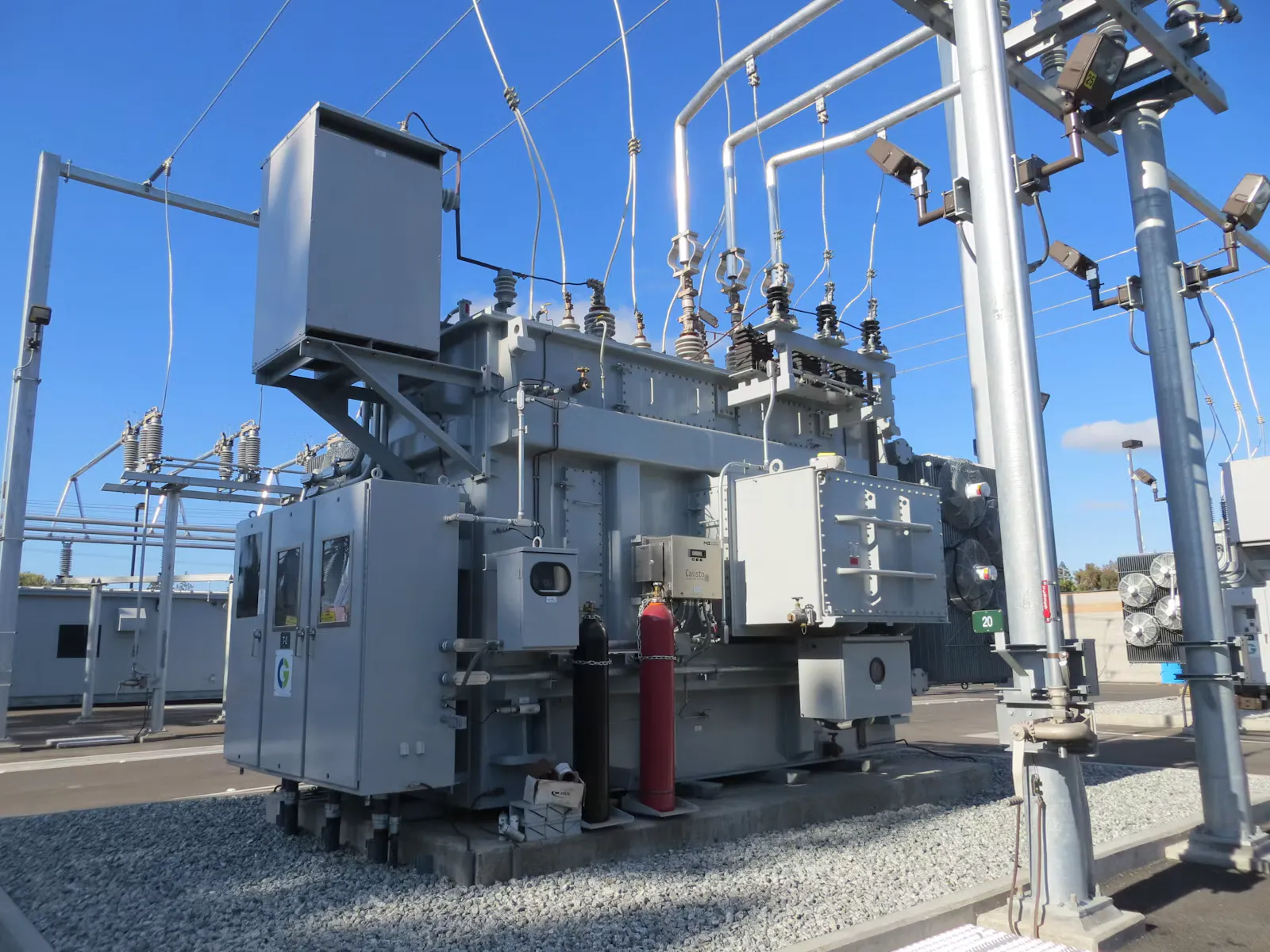
Real transformers lose a little energy, and NCERT says a well designed one can still be more than 95% efficient. It names four losses, which make an easy one-mark question:
- Flux leakage: some primary flux misses the secondary; winding the coils one over the other reduces it.
- Resistance of the windings: I²R heating in the wire; thick wire on the high current side reduces it.
- Eddy currents: heating of the iron core; a laminated core reduces it.
- Hysteresis: energy lost each time the core's magnetisation reverses; a low hysteresis core material reduces it.
Power stations step the voltage up before long distance transmission so that the current, and with it the I²R loss in the lines, is small. Sub-stations near homes step it back down. The derivation of Vs/Vp = Ns/Np assumes small primary resistance and current, no flux leakage and a small secondary current, so an "ideal transformer" in a question means exactly those three things.
Eight traps that cost marks in Unit 14
Most marks lost in electromagnetic induction come from signs, units and one misread word, not from hard physics. These are the ones we see most often.
- Flipping a coil through 180° doubles the flux change. The flux goes from +Φ to -Φ, so ΔΦ = 2Φ, as in NCERT Example 6.3.
- Using the angle with the plane instead of the normal. Φ = BA cos θ uses the angle with the area vector. A loop whose plane is perpendicular to B has the maximum flux.
- Revolutions are not radians. In (1/2)BωR² and NBAω, convert first: 50 rev/s is 100π rad/s, 120 rev/min is 4π rad/s.
- Counting spokes. In a wheel the spokes are in parallel, so 10 spokes give the same emf as one.
- A steady field induces nothing. No change in flux, no emf, however strong the magnet.
- Adding AC voltages like numbers. In NCERT Example 7.6, VR = 151 V and VC = 160.3 V add to 311.3 V as numbers, but the source is 220 V. They are 90° apart, so the right sum is √(VR² + VC²) = 220 V.
- Treating rms and peak as the same. Meters and ratings read rms. Multiply by √2 to get the peak, so 220 V rms is 311 V peak.
- Thinking the self-induced emf opposes the current. It opposes the change in current. When a current is switched off, the back emf tries to keep it flowing.
A 7-day revision plan for electromagnetic induction
Electromagnetic induction rewards short daily practice more than one long session, because the direction questions and the numericals use different skills. NCERT gives you 8 exercises at the end of Chapter 6 and 8 at the end of Chapter 7; do all 16.
- Day 1: Flux and Faraday's law. Redo NCERT Examples 6.2 and 6.3 without looking, then Exercise 6.3 (our answer: about 7.5 × 10^-6 V).
- Day 2: Lenz's law. Draw the four-step method for Exercises 6.1 and 6.2 and Example 6.4.
- Day 3: Motional emf. Examples 6.6 and 6.7, then Exercises 6.4, 6.5 and 6.6.
- Day 4: Inductance and energy. Derive L = μ0n²Al once, then Exercises 6.7 and 6.8.
- Day 5: AC basics. rms and peak, XL and XC, Examples 7.1, 7.2 and 7.4 and Exercises 7.1 to 7.5.
- Day 6: LCR, resonance, power factor and the transformer. Example 7.6 and Exercises 7.6 to 7.8, then the four transformer losses from memory.
- Day 7: A timed mixed set of 20 questions from both chapters, then a list of every mistake and which trap above it was.
For the formulas next to the rest of the subject, keep our NEET Physics formula sheet open while you practise. Unit 14 leans on the magnetism chapter before it and sits beside our guides on current electricity for NEET and ray optics for NEET, and the overall plan is in our NEET 2027 Physics preparation strategy.
For a revision order across all three subjects, futureMBBS's NEET 2027 chapter-wise weightage guide is a sensible next read, and its NEET syllabus overview keeps all the units on one page. If you are unsure which NCERT edition to study from, its explainer on what the NCERT book is helps.
Want to know whether electromagnetic induction is where your Physics marks leak? NEETsheet's chapter-wise Physics sets and timed mocks show which trap you keep falling into, so your next revision goes there first. Start at neetsheet.in.
Sources
All links were checked on 3 November 2026.
- National Medical Commission (UGMEB), Syllabus for NEET (UG) 2026, public notice of 22 December 2025 (Physics Unit 14; Unit 20 experiments): https://cdnbbsr.s3waas.gov.in/s37bc1ec1d9c3426357e69acd5bf320061/uploads/2026/01/202601081066816297.pdf
- National Testing Agency, Information Bulletin NEET (UG) 2026 (pattern: Physics 45 questions and 180 of 720 marks; plus four and minus one marking; syllabus FAQ): https://cdnbbsr.s3waas.gov.in/s37bc1ec1d9c3426357e69acd5bf320061/uploads/2026/02/202602231394640855.pdf
- National Testing Agency, NEET (UG) public notices, checked on 3 November 2026 for any NEET (UG) 2027 notice: https://neet.nta.nic.in/public-notices/
- NCERT, Physics Class 12 Part I, Chapter 6 Electromagnetic Induction, reprint 2026-27 (sections 6.2 to 6.8; Examples 6.2 to 6.10; Exercises 6.1 to 6.8): https://ncert.nic.in/textbook/pdf/leph106.pdf
- NCERT, Physics Class 12 Part I, Chapter 7 Alternating Current, reprint 2026-27 (sections 7.2 to 7.8; Examples 7.1 to 7.7; Exercises 7.1 to 7.8): https://ncert.nic.in/textbook/pdf/leph107.pdf
- National Institute of Standards and Technology, CODATA 2022 value of the vacuum magnetic permeability, 1.25663706127 × 10^-6 N A^-2: https://physics.nist.gov/cgi-bin/cuu/Value?mu0
Frequently Asked Questions
Electromagnetic induction is the production of an emf, and so a current in a closed circuit, by a changing magnetic flux. Faraday and Henry showed it around 1830. The flux can change through the field, the area or the angle. A steady flux induces nothing, however strong the magnet. It is the principle behind generators and transformers.
Yes, as far as anyone can say today. Electromagnetic induction is in Physics Unit 14, together with alternating currents, in the NMC syllabus for NEET (UG) 2026, and the 2026 bulletin says the syllabus did not change from the previous year. No NEET (UG) 2027 syllabus had been published by 3 November 2026.
Electromagnetic induction is a Class 12 topic. It is Chapter 6 of NCERT Physics Class 12 Part I (reprint 2026-27), and Chapter 7, Alternating Current, completes NEET Unit 14. It builds on the Class 12 chapters on moving charges and magnetism, so revise those first if magnetic fields feel shaky.
Faraday's law says the magnitude of the induced emf in a circuit equals the rate of change of magnetic flux through it. For a coil of N turns, ε = -N dΦ/dt, where Φ = BA cos θ. The minus sign is Lenz's law: the induced current opposes the change in flux that produced it.
Yes. The NMC syllabus for NEET (UG) 2026 names eddy currents in Unit 14. The 2026-27 NCERT reprint has no separate eddy current section in Chapter 6, though; it explains them in the Chapter 7 transformer section as currents induced in the iron core that cause heating and are reduced by a laminated core.