
Current Electricity for NEET: Unit 12 Formulas and Traps
Current electricity is Unit 12 of the NEET (UG) Physics syllabus: the study of charges moving steadily through conductors, and of the circuits that carry them. For NEET it means a short, fixed list of ideas: drift velocity, Ohm's law, resistance and resistivity, power, series and parallel resistors, cells with internal resistance, Kirchhoff's laws, the Wheatstone bridge and the metre bridge. This guide takes current electricity for NEET line by line, gives every formula with the condition under which it holds, works out the numbers that surprise most students, and ends with a revision plan you can start this week.
What is current electricity in the NEET syllabus?
Current electricity in NEET is exactly what the syllabus prints under Unit 12, no more and no less. The NEET (UG) syllabus that the official NEET site links for the 2026 exam (the file itself is headed "Syllabus for NEET (UG) 2025") gives the unit two short paragraphs. Here they are, split into phrases, with what each phrase actually expects from you.
| Syllabus phrase (Unit 12) | What you should be able to do |
|---|---|
| Electric current | Define current as charge per unit time and use I = q/t |
| Drift velocity, mobility and their relation with electric current | Use I = neAvd and μ = vd/E, and explain why vd is tiny |
| Ohm's law, electrical resistance | Use V = IR and know when it fails |
| V-I characteristics of ohmic and non-ohmic conductors | Read a straight line through the origin versus a curve |
| Electrical energy and power | Use P = VI = I²R = V²/R and pick the right form |
| Electrical resistivity and conductivity | Use R = ρL/A and σ = 1/ρ, and know ρ is a material property |
| Series and parallel combinations of resistors | Reduce any network of resistors to one value |
| Temperature dependence of resistance | Use ρ = ρ₀[1 + α(T minus T₀)] for metals |
| Internal resistance, potential difference and emf of a cell | Use V = E minus Ir, and V = E + Ir while charging |
| Combination of cells in series and parallel | Find the equivalent emf and internal resistance |
| Kirchhoff's laws and their applications | Write junction and loop equations with correct signs |
| Wheatstone bridge, metre bridge | Use the balance condition P/Q = R/S and its metre bridge form |
Is current electricity still in NEET 2027? Yes, as far as anyone can say today. The NEET (UG) 2026 Information Bulletin answers its own syllabus FAQ with "there is no change in the syllabus of NEET (UG) 2026 with respect to the previous year", and the NEET public notices page had no 2027 syllabus notice when we checked on 26 October 2026. If the 2027 syllabus changes Unit 12, our NEET 2027 deleted syllabus guide is where we will flag it first.
How many marks can current electricity decide?
Nobody can give you an official number. The bulletin fixes the paper, not the chapter split: Physics has 45 questions worth 180 of the 720 marks, every right answer earns plus four, every wrong answer costs one, and a blank scores zero. NTA has never published how many questions each unit gets.
That still tells you something useful. One Physics question is worth 4 marks, and a wrong guess swings you by 5 marks against a correct answer. Current electricity questions are mostly calculations that either work or do not, so this is a chapter where accuracy pays and guessing hurts. Our NEET negative marking guide explains the arithmetic of when a guess is worth it, and our NEET Physics questions guide shows how all 45 questions are marked.
Current electricity formulas, each with its condition
Fewer than you think. Every formula below is standard Class 12 physics, and the right hand column is the part most formula lists leave out: the condition under which each one is true.
| Quantity | Formula | Holds when |
|---|---|---|
| Current | I = q/t | Steady current; for a varying one, I = dq/dt |
| Current and drift | I = neAvd | n is free electrons per m³, A the cross-section |
| Mobility | μ = vd/E | Drift speed per unit electric field |
| Ohm's law | V = IR | Ohmic conductor at constant temperature |
| Resistance | R = ρL/A | Uniform wire of length L and area A |
| Conductivity | σ = 1/ρ | Always; units S/m |
| Power | P = VI = I²R = V²/R | Use I²R for series, V²/R for parallel |
| Series resistors | R = R₁ + R₂ + R₃ | Same current through each |
| Parallel resistors | 1/R = 1/R₁ + 1/R₂ + 1/R₃ | Same voltage across each |
| Temperature | ρ = ρ₀[1 + α(T minus T₀)] | Metals over a moderate range; α positive |
| Cell, discharging | V = E minus Ir | Cell supplying current |
| Cell, charging | V = E + Ir | Current forced into the cell |
| Maximum power to load | R = r | External resistance equals internal resistance |
| Wheatstone balance | P/Q = R/S | Galvanometer current zero |
| Metre bridge | R/S = l/(100 minus l) | l in cm from the end next to R |
Notice the one pair that flips across chapters: resistors in series simply add, but capacitors in series add as reciprocals. Our NEET physics formula sheet puts the two side by side with all 20 units, so use it for the wider picture and this page for current electricity in depth.
How fast do electrons really move in a wire?
Far more slowly than most students guess, and this is the single most surprising number in current electricity. We can work it out from official constants rather than from a textbook value.
Start with copper. PubChem's periodic table, run by the US National Institutes of Health, gives copper a density of 8.933 g/cm³ and an atomic mass of 63.55. NIST gives the Avogadro constant as exactly 6.02214076 × 10^23 per mole and the elementary charge as exactly 1.602176634 × 10^-19 C. Assume one free electron per copper atom, which is the usual textbook assumption, and the numbers run like this:
- Atoms per cubic metre: 8,933 kg/m³ divided by 0.06355 kg/mol, times 6.022 × 10^23, gives n of about 8.47 × 10^28 per m³.
- Take a wire with a cross-section of 1 mm², which is 1 × 10^-6 m², carrying 1 A.
- Rearrange I = neAvd to vd = I/(neA).
- vd = 1 / (8.47 × 10^28 × 1.602 × 10^-19 × 1 × 10^-6), which is about 7.4 × 10^-5 m/s.
That is roughly 0.074 mm per second. At that speed an electron needs close to four hours to drift one metre along the wire. So why does a bulb light the moment you flip the switch? Because the electric field travels through the circuit almost instantly and sets every free electron in the wire drifting at once. The electrons near the bulb start moving straight away; none of them has to arrive from the switch.
How many electrons is one ampere? NIST's page on the ampere explains that since 20 May 2019 the ampere is based on the elementary charge, and that one ampere is one coulomb passing a point each second. Divide 1 C by 1.602176634 × 10^-19 C and you get about 6.24 × 10^18 electrons per second. That huge count and that tiny drift speed are the same fact seen from two sides: a current is a vast number of slow charges, not a few fast ones.
How do series and parallel resistors change the answer?
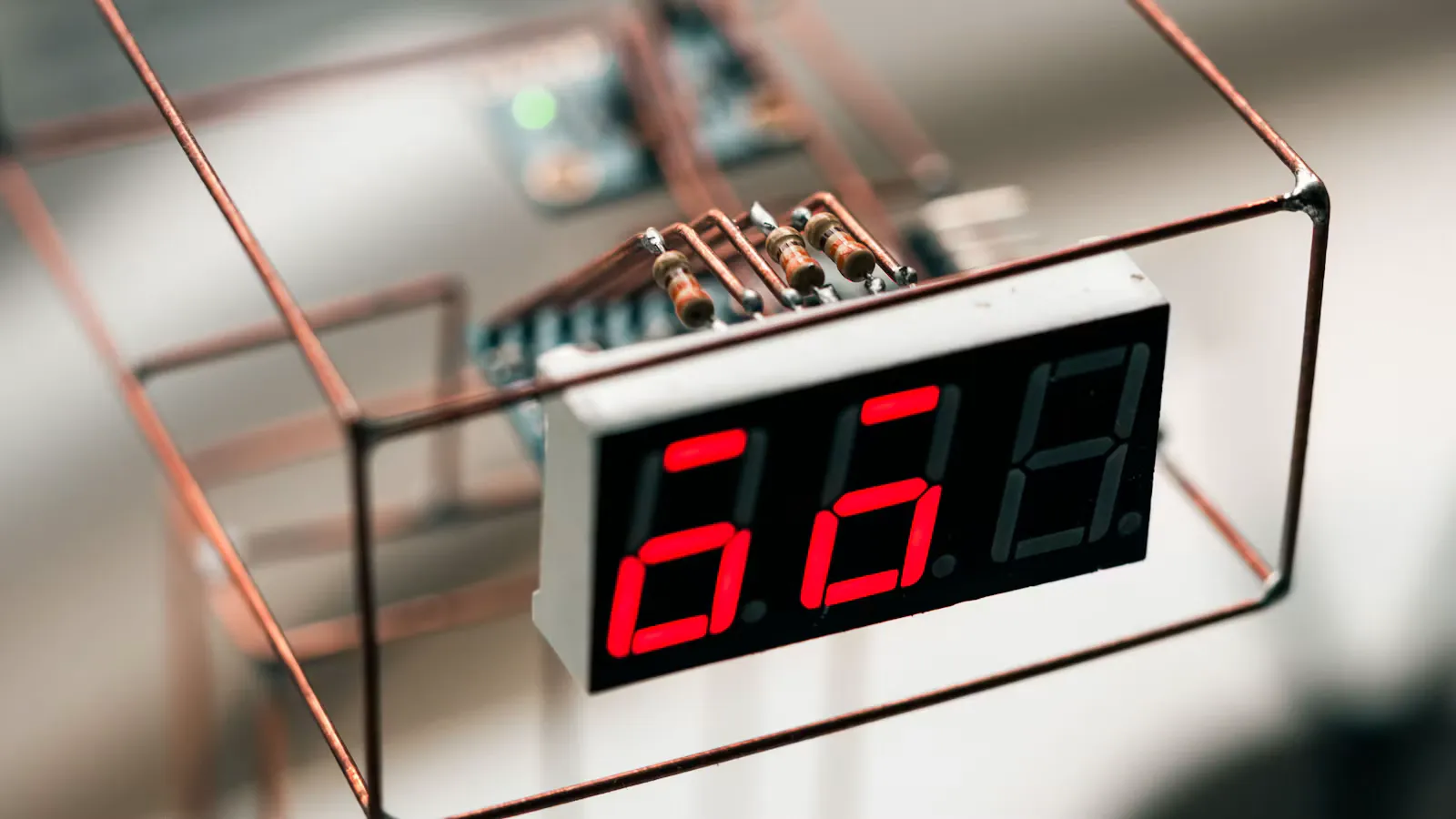
The arrangement matters more than the parts. Take three identical 6 Ω resistors and you can build four different equivalent resistances from the same box of components. The chart shows our own arithmetic.
Two checks catch most mistakes in current electricity networks. First, a parallel combination is always smaller than its smallest branch: 2 Ω is smaller than 6 Ω, as it must be. Second, n identical resistors R in parallel give R/n, so you can often skip the reciprocal arithmetic. When a network looks symmetric, look for points at the same potential before you start writing equations; a resistor between two such points carries no current and can be removed.
What do emf and internal resistance change?
The emf E of a cell is the energy it gives each coulomb; the terminal voltage V is what is left for the outside circuit after the cell's own internal resistance r takes its share. They are equal only when no current flows.
A worked example makes it concrete. A cell of emf 1.5 V and internal resistance 0.5 Ω drives a 2.5 Ω resistor:
- Current: I = E/(R + r) = 1.5/3.0 = 0.5 A.
- Terminal voltage: V = E minus Ir = 1.5 minus 0.25 = 1.25 V.
- Power in the load: I²R = 0.25 × 2.5 = 0.625 W.
Change the load to 0.5 Ω, equal to r, and the current becomes 1.5 A while the power in the load rises to 1.125 W, which is the most this cell can deliver to any external resistor. That is the maximum power condition R = r, and NEET likes it because it looks like an optimisation problem but needs only one line.
For cells in combination, keep two rules. In series, emfs add (with signs, if a cell is reversed) and internal resistances add. For identical cells in parallel, the emf stays E and the internal resistance becomes r divided by the number of cells. For unequal cells in parallel, do not use a shortcut you are unsure of: solve it with Kirchhoff's laws.
How do you apply Kirchhoff's laws without sign errors?
Kirchhoff's junction law says the currents entering a junction equal the currents leaving it, because charge is conserved. The loop law says the sum of potential changes around any closed loop is zero, because energy is conserved. Almost every error comes from signs, so use the same routine every time:
- Label every branch current with an arrow. Guess the direction; a negative answer just means the real current flows the other way.
- Write the junction equations first. With j junctions you need j minus 1 of them.
- Pick independent loops and a direction to walk each one, say clockwise.
- Walking through a resistor in the direction of its current, write minus IR. Against the current, write plus IR.
- Walking through a cell from the negative to the positive terminal, write plus E. From positive to negative, write minus E.
Then solve the equations together. Check the answer in a loop you did not use; if the potential changes do not add to zero, a sign is wrong somewhere. This routine is slow the first ten times and automatic after that, which is the point of practising current electricity on paper before you do it on a timer.
The Wheatstone bridge and the metre bridge
A Wheatstone bridge is four resistors P, Q, R and S in a diamond, with a galvanometer across the middle. It is balanced, and the galvanometer reads zero, when P/Q = R/S. At balance the middle branch carries no current, so it can be removed from the circuit, which is the trick behind many current electricity questions that look harder than they are.
The metre bridge is the same idea built on a uniform one metre wire. The jockey slides along the wire until the galvanometer reads zero at a length l from one end. Because the wire is uniform, resistance is proportional to length, and the balance condition becomes R/S = l/(100 minus l), with l in centimetres. If balance comes at 40 cm with a known S of 6 Ω, then R = 6 × 40/60 = 4 Ω.
The metre bridge also appears in the practical part of the syllabus, which brings us to Unit 20.
Which Unit 20 experiments belong to current electricity?
Unit 20, Experimental Skills, asks for "familiarity with the basic approach and observations" of a list of experiments. Three of them sit inside current electricity:
| Unit 20 item | What it measures | What NEET can ask |
|---|---|---|
| 10. Resistivity using a metre bridge | ρ of the material of a wire | Balance length, then ρ = RA/L |
| 11. Resistance using Ohm's law | R of a wire | Slope of a V-I graph |
| 18. Identification of diode, LED, resistor, capacitor | Telling components apart | Which component shows which behaviour |
Item 12, the resistance and figure of merit of a galvanometer by half deflection, uses a circuit too, but the galvanometer itself belongs to Unit 13, Magnetic Effects of Current and Magnetism. Read the observations for each experiment, not just the formula: questions on Unit 20 often ask what you would see, such as a straight V-I line for a metal wire.
What is not in the Unit 12 syllabus line?
The potentiometer. The Unit 12 text names the Wheatstone bridge and the metre bridge and stops there, and the potentiometer does not appear anywhere in the Physics syllabus, including the Unit 20 experiment list. Older question banks and older editions of reference books still carry potentiometer problems. Under the current syllabus you can treat them as optional practice in Kirchhoff's laws, not as a topic to master.
Two cautions. This is an absence argument: it holds for the syllabus file linked for 2026, and a 2027 syllabus could word Unit 12 differently. And the colour code of resistors is not named in the Unit 12 line either, but Unit 20 item 18 asks you to identify a resistor, so knowing what a resistor looks like is still fair game.
Eight current electricity traps that cost marks
These are the places where a correct method still produces a wrong option.
- Power with the wrong formula. P = I²R and P = V²/R give opposite trends. Two bulbs in series share the same current, so the higher resistance bulb glows brighter. In parallel they share the same voltage, so the lower resistance bulb glows brighter.
- Stretching a wire. Volume stays constant, so stretching a wire to n times its length makes its area 1/n, and its resistance n² times the original, not n times.
- Resistivity versus resistance. Cutting a wire in half halves R but leaves ρ unchanged; ρ depends on the material and temperature only.
- Drift speed and current. For the same current, a thinner wire has a higher drift speed, because vd = I/(neA).
- Terminal voltage while charging. It is E + Ir, not E minus Ir.
- Ohm's law as a law of nature. It is not universal. Diodes and filament lamps give non-ohmic, curved V-I graphs.
- Temperature. Metals have a positive temperature coefficient; their resistance rises when heated. Do not carry that rule over to semiconductors.
- Balanced bridge branch. At balance the galvanometer branch carries zero current, whatever its own resistance, so you can delete it before simplifying.
How should you revise current electricity for NEET?
Give it a week of focused work, then keep it alive with short reviews. Here is a plan that fits around school or a dropper's day.
- Day 1: read the unit against the syllabus. Use the phrase table at the top of this guide as a checklist and tick each line only when you can explain it out loud.
- Day 2: build the formula table yourself. Write each current electricity formula with its condition and SI unit, then compare it with the table above.
- Day 3: networks. Twenty series and parallel problems, checking every answer with the two sanity checks from the chart section.
- Day 4: cells and Kirchhoff. Ten loop problems with the five-step routine, written out in full.
- Day 5: bridges and Unit 20. Wheatstone and metre bridge problems, then the observations for experiments 10, 11 and 18.
- Day 6 and after: mixed and timed. Solve old NEET Physics questions on this unit under a timer and log every wrong answer by trap number. Turn each trap into a flashcard, as our NEET flashcards guide shows.
Previous papers are the best timed practice, and our NEET previous year question papers guide shows how to use them without burning through them too early. For where this unit sits in the full Physics plan, see our NEET 2027 Physics preparation strategy, and when you reach the end of Class 12, modern physics for NEET follows the same chapter-guide format.
On our sister site, futureMBBS keeps a NEET syllabus overview that puts all three subjects on one page, a NEET 2027 chapter-wise weightage guide for deciding how chapters sit against each other in your revision order, and a plain explainer on why NEET leans on the NCERT book. For the wider plan beyond one chapter, its guide on how to prepare for NEET is a sensible next read.
Want to see whether current electricity is actually costing you marks? NEETsheet's chapter-wise Physics sets and full-length mocks show which trap you keep falling into, so your next revision session goes there first. Start at neetsheet.in.
Sources
Every syllabus line and number above comes from these documents, opened and read on 26 October 2026.
- National Testing Agency, NEET (UG) syllabus file linked from neet.nta.nic.in as the syllabus for the 2026 examination, headed "Syllabus for NEET (UG) 2025" (Physics Unit 12, Current Electricity, and Unit 20, Experimental Skills): https://cdnbbsr.s3waas.gov.in/s37bc1ec1d9c3426357e69acd5bf320061/uploads/2026/01/20260102588210790.pdf
- National Testing Agency, Information Bulletin NEET (UG) 2026 (pattern: Physics 45 questions and 180 of 720 marks; plus four, minus one and zero marking; syllabus FAQ stating no change for 2026): https://cdnbbsr.s3waas.gov.in/s37bc1ec1d9c3426357e69acd5bf320061/uploads/2026/02/202602231394640855.pdf
- National Testing Agency, NEET (UG) public notices, checked on 26 October 2026 for any NEET (UG) 2027 notice: https://neet.nta.nic.in/public-notices/
- NIST, CODATA value of the elementary charge (1.602176634 × 10^-19 C, exact): https://physics.nist.gov/cgi-bin/cuu/Value?e
- NIST, CODATA value of the Avogadro constant (6.02214076 × 10^23 per mol, exact): https://physics.nist.gov/cgi-bin/cuu/Value?na
- NIST, SI redefinition, the ampere (based on the elementary charge since 20 May 2019; one ampere is one coulomb per second): https://www.nist.gov/si-redefinition/ampere-introduction
- PubChem, US National Library of Medicine, Periodic Table of Elements (copper: density 8.933 g/cm³, atomic mass 63.55): https://pubchem.ncbi.nlm.nih.gov/periodic-table/
Frequently Asked Questions
Yes, as far as anyone can say today. Current electricity is Unit 12 of the NEET (UG) Physics syllabus linked for the 2026 exam, and the 2026 bulletin says the syllabus did not change from the previous year. No NEET (UG) 2027 syllabus had been published by 26 October 2026.
Current electricity is Unit 12 of the 20 Physics units, between Unit 11, Electrostatics, and Unit 13, Magnetic Effects of Current and Magnetism. It uses the electric field and potential from Unit 11, so revise that unit first, and it feeds straight into the galvanometer and magnetism work of Unit 13.
No. The Unit 12 line names the Wheatstone bridge and the metre bridge, and the potentiometer does not appear anywhere in the Physics syllabus linked for 2026, including the Unit 20 experiment list. Treat old potentiometer problems as optional Kirchhoff practice and recheck when the 2027 syllabus appears.
There is no official number. NTA publishes the subject pattern, 45 Physics questions for 180 marks in NEET (UG) 2026, but not a chapter-wise split. Treat any fixed count you see online as an estimate and prepare the whole of Unit 12 properly.
The electric field, not the electrons, travels round the circuit almost instantly, so every free electron starts drifting at once. Each one moves very slowly: about 0.074 mm per second in a 1 mm² copper wire carrying 1 A, by our calculation from NIST and PubChem data.