
Gravitation for NEET: Unit 6 Formulas, Satellites and Traps
Gravitation is the force of attraction that every mass exerts on every other mass, and for NEET it is Physics Unit 6 of the NMC syllabus, taught in NCERT Class 11 Physics Chapter 7. The unit is short but formula heavy: Newton's law, the change in g with height and depth, Kepler's laws, potential energy, escape speed and satellites. This guide covers gravitation for NEET line by line against the syllabus, works the NCERT numbers, and lists the traps that turn a sure four marks into minus one.
What is gravitation?
Gravitation is the universal attraction between any two bodies that have mass. Its strength grows with the product of the masses and falls with the square of the distance between them. On Earth we feel it as weight, and in space it keeps the Moon and every satellite in orbit. NEET tests it as Physics Unit 6.
The word covers two things that students often mix up. "Gravitation" is the general force between any pair of masses. "Gravity" usually means the Earth's own pull on objects near it, which is why the acceleration it produces is written g and called the acceleration due to gravity. Every formula in this unit is one of those two ideas, seen from a different distance.
Where is gravitation in the NEET syllabus?
Gravitation sits in Physics Unit 6 of the NMC syllabus for NEET (UG) 2026, notified on 22 December 2025. The unit text is only four lines long. Read it as a checklist: each phrase below is a question type you should be able to solve, and each maps to one part of NCERT Chapter 7.
| Syllabus phrase (Unit 6) | Where NCERT teaches it | What the questions ask |
|---|---|---|
| The universal law of gravitation | Law of gravitation, section 7.4 on G | Force between masses, superposition, shells |
| Acceleration due to gravity and its variation with altitude and depth | Sections 7.5 and 7.6 | g at height h, g at depth d, ratios |
| Kepler's law of planetary motion | Section 7.2 | Orbits, equal areas, T² ∝ r³ |
| Gravitational potential energy; gravitational potential | Potential energy section, Example 7.3 | Energy of a system of masses, potential at a point |
| Escape velocity | Section 7.8, Example 7.4 | 11.2 km/s, escape from other planets |
| Motion of a satellite, orbital velocity, time period and energy of satellite | Sections 7.9 and 7.10 | Speed, period, energy at height h |
The NEET (UG) 2026 information bulletin answers "Is there any change in the syllabus?" with "No". As of 7 November 2026, neither neet.nta.nic.in nor NTA's examination calendar up to April 2027 shows a NEET (UG) 2027 notice, so the 2026 text is the latest official version. Recheck this table on the day the 2027 bulletin appears.
How many marks ride on gravitation?
Gravitation competes for marks inside a Physics section of 45 questions worth 180 of the 720 marks, answered in a 180 minute paper, as the 2026 bulletin fixes it. NTA does not publish how many questions come from each unit, so any exact gravitation question count you see online is an estimate, not an official figure.
What the bulletin does fix is the marking. A correct answer earns plus four, a wrong one costs minus one, and an unanswered question scores zero. Gravitation questions are short, so a wrong squared term or a forgotten √2 is a cheap way to lose five marks of swing. Our page on negative marking in NEET explains when guessing is worth it.
What does the universal law of gravitation say?
The universal law of gravitation says every point mass attracts every other point mass with a force F = Gm₁m₂/r², acting along the line joining them. G is a universal constant. NCERT gives its accepted value as 6.67 × 10⁻¹¹ N m²/kg², first measured by Henry Cavendish in 1798 with a torsion balance.
Three results from NCERT Chapter 7 carry most of the questions built on this law.
- Forces add as vectors. With several masses, you find each force separately and add them by the principle of superposition. NCERT's Fig. 7.5 example puts three equal masses at the corners of a triangle and shows the net force on a mass at the centroid is zero, which symmetry already tells you.
- A shell acts like a point outside. A uniform hollow spherical shell attracts a point mass outside it as if all its mass sat at its centre.
- A shell exerts nothing inside. The same shell exerts zero net force on a point mass anywhere inside it. Unlike electric forces, though, gravitation cannot be shielded: bodies outside the shell still pull on the mass inside.
Cavendish's measurement is why NCERT repeats the line that he "weighed the earth". Once G is known, g = GM/R² gives the Earth's mass. In Example 7.6, with g = 9.81 m/s² and R = 6.37 × 10⁶ m, NCERT gets 5.97 × 10²⁴ kg, and a second method using the Moon's orbit agrees within 1%.
Kepler's three laws in one table
Kepler drew these laws from Tycho Brahe's naked-eye records of the planets, and Newton later used them to build the law of gravitation. NEET asks them both as statements and as numbers.
| Law | Statement in NCERT | How it is tested |
|---|---|---|
| Law of orbits | Planets move in ellipses with the Sun at one focus | Perihelion and aphelion, the circle as a special case |
| Law of areas | The line from the Sun to a planet sweeps equal areas in equal times | Speed is higher at perihelion than aphelion |
| Law of periods | T² is proportional to the cube of the semi-major axis | Ratios of periods and radii |
Two details from the chapter's "Points to Ponder" are worth a flashcard each. The law of areas follows from conservation of angular momentum, and it holds for any central force, not only an inverse square one. And in motion under gravitation, angular momentum and total mechanical energy are conserved, but linear momentum is not.
The law of periods turns into a one-line calculation. NCERT's Example 7.5 takes Mars's orbit as 1.52 times the Earth's and gets a Martian year of (1.52)^(3/2) × 365 = 684 days. Ratios like this are the most common Kepler question.
How does g change with height and depth?
Acceleration due to gravity falls both above and below the Earth's surface, but at different rates. At a small height h, g(h) ≈ g(1 - 2h/R). At a depth d, g(d) = g(1 - d/R), and at the centre it is zero. For the same small distance, going up costs twice as much as going down.
Our arithmetic makes the gap concrete. With R = 6,400 km, a height of 32 km gives 2h/R = 0.01, so g drops about 1%. You have to go 64 km down to lose the same 1%. The depth formula comes from NCERT's model of a uniform Earth, where only the sphere below you pulls on you and the outer shell contributes nothing.
NCERT's Exercise 7.16 tests exactly this. A body weighs 250 N on the surface. Halfway to the centre, d = R/2, so g(d) = g/2 and the body weighs 125 N. Notice that the height formula would give nonsense if you used it at h = R: 1 - 2 = -1. The approximation only holds when h is much smaller than R. For large heights use the exact form, g(h) = g R²/(R + h)², which gives g/4 at h = R.
If your Newton's law basics wobble here, revisit laws of motion for NEET first, because every gravitation problem starts from F = ma.
What is gravitational potential energy?
Gravitational potential energy of two masses is the work needed to bring them from infinite separation to a distance r apart. NCERT writes it as V = -Gm₁m₂/r, taking zero at infinity. It is negative because gravitation is attractive, and the familiar mgh is only an approximation to a difference in this energy near the surface.
Gravitational potential is the same quantity per unit mass: the potential energy a 1 kg mass would have at that point, -GM/r for the Earth outside its surface. For several masses you add the energy of every pair, which is superposition again. NCERT's Example 7.3 puts four equal masses at the corners of a square of side l. Four pairs sit at distance l and two diagonal pairs at √2 l, which gives a total of about -5.41 Gm²/l.
The trap is counting pairs. Four masses make six pairs, not four. Write the pairs out before you touch the formula.
What is escape velocity?
Escape velocity is the minimum speed a body needs at the surface to reach infinity and never fall back. Energy conservation gives v = √(2GM/R) = √(2gR). For the Earth, NCERT works this out as about 11.2 km/s, and it does not depend on the mass of the body or the direction it is thrown.
NCERT also gives the Moon's escape speed as 2.3 km/s, about five times smaller, which is why the Moon has kept no atmosphere. The NASA Moon fact sheet lists 2.38 km/s for the Moon against 11.2 km/s for the Earth, and a surface gravity of 1.62 m/s², about 0.165 of the Earth's 9.80 m/s².
Two worked numbers from the chapter's exercises are good practice.
- Exercise 7.18. A body leaves the Earth at three times the escape speed. Energy conservation gives v² far away = (3ve)² - ve² = 8ve², so the final speed is 2√2 × 11.2 ≈ 31.7 km/s.
- Example 7.4. A projectile goes from a sphere of mass M towards one of mass 4M, centres 6R apart. The forces cancel at the neutral point 2R from the smaller sphere, and the minimum launch speed works out as √(3GM/5R). Past that point, the bigger sphere does the rest.
Satellites: orbital speed, period and energy
For a satellite in a circular orbit of radius r = R + h, gravitation supplies the centripetal force, so v² = GM/r. Speed falls as the orbit gets higher. The period follows from distance over speed, T = 2π√(r³/GM), which is Kepler's law of periods applied to satellites.
| Quantity | Formula (r = R + h) | Near the surface (h ≈ 0) |
|---|---|---|
| Orbital speed | v = √(GM/r) | √(gR) ≈ 7.9 km/s |
| Time period | T = 2π√(r³/GM) | 2π√(R/g) ≈ 85 minutes |
| Kinetic energy | GMm/2r | Positive |
| Potential energy | -GMm/r | Negative, twice the kinetic energy in size |
| Total energy | -GMm/2r | Negative, so the satellite stays bound |
| Escape speed for comparison | √(2GM/R) | √(2gR) ≈ 11.2 km/s |
The 7.9 km/s and the √2 ratio are our arithmetic from NCERT's values g = 9.8 m/s² and R = 6,400 km; the 85 minutes is NCERT's own figure. The Moon is the Earth's only natural satellite, with a period of about 27.3 days.
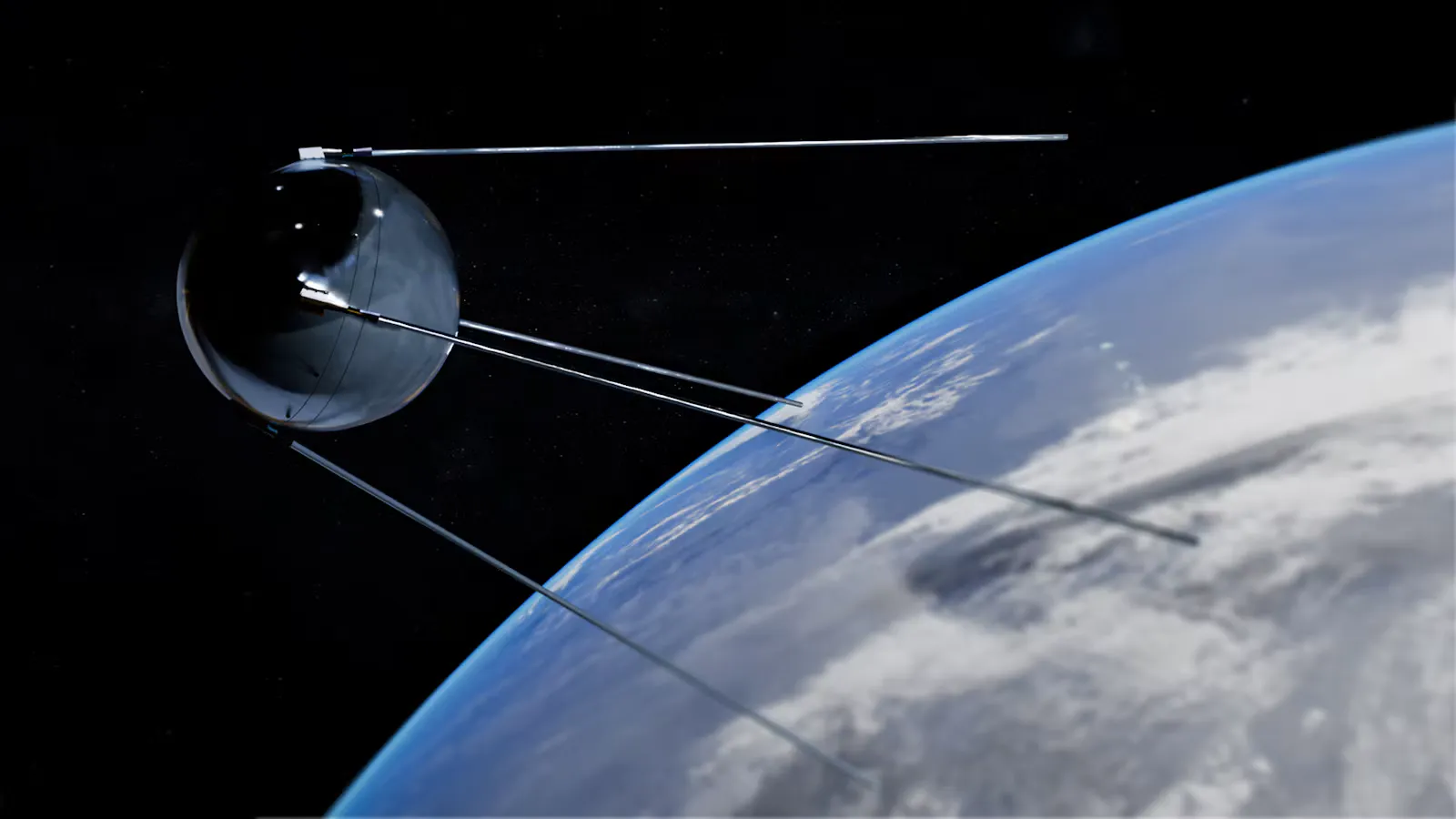
Why is the total energy negative? Because the satellite is bound. NCERT's point is that if the total energy were zero or positive, the object would escape to infinity. This also answers the weightlessness question: an astronaut floats not because gravity is weak up there, but because the astronaut and the satellite are falling freely together.
One more thing NCERT notes. The same energy result holds for an elliptical orbit if you replace r with the semi-major axis a, giving E = -GMm/2a. The kinetic and potential energies change around the ellipse, but their sum does not.
Seven traps in gravitation questions
Most marks in gravitation are lost on setup, not on difficult physics. Check every answer against these seven.
- Measuring r from the surface. In every formula, r is measured from the centre of the Earth, so a satellite at height h has r = R + h.
- Using 1 - 2h/R for a big height. It is valid only for h much smaller than R. At h = R the exact answer is g/4.
- Mixing the height and depth factors. Height has the 2, depth does not. Write both on one card.
- Thinking escape speed depends on mass or angle. It depends only on the planet's M and R, so a 1 kg ball and a rocket need the same 11.2 km/s.
- Forgetting the minus signs. Potential energy and total satellite energy are negative. Binding energy is the positive amount, GMm/2r, needed to free the satellite.
- Counting pairs wrongly. n masses make n(n - 1)/2 pairs. Four masses make six.
- Calling the shell a shield. The net force from a shell on a mass inside is zero, but gravitation cannot be shielded from other bodies.
A five-day revision plan for gravitation
The chapter is short enough for one working week at about an hour a day. Do it in this order, because each day uses the one before.
- Day 1: Read Kepler's laws and the law of gravitation. Solve the triangle example and NCERT Example 7.5 on the Martian year.
- Day 2: Sections 7.5 and 7.6. Derive g(h) and g(d) yourself, redraw the chart above from memory, and solve Exercise 7.16.
- Day 3: Potential energy and potential. Solve Example 7.3 and write the pair count for three, four and five masses.
- Day 4: Section 7.8. Derive escape speed from energy conservation and solve Example 7.4 and Exercises 7.17 and 7.18.
- Day 5: Sections 7.9 and 7.10, then a timed set of 20 mixed gravitation questions at about a minute each. Log every r-from-surface error separately.
Once the chapter is done, place it in your wider plan. The NEET 2027 chapter-wise weightage guide on futureMBBS helps you decide where mechanics sits in your revision order, and its NEET syllabus overview shows every Physics unit on one page. For pacing full papers, read the time management guide for the NEET exam. On our side, keep the NEET Physics formula sheet next to you, and use NEET Physics questions for the subject-wide picture.
If gravitation is where your Physics marks slip, NEETsheet's chapter-wise practice and timed mocks show whether the problem is the formula or the setup, so your next hour goes to the right place. Start at neetsheet.in.
Sources
All links were checked on 7 November 2026.
- National Medical Commission (UGMEB), Syllabus for NEET (UG) 2026, public notice of 22 December 2025 (Physics Unit 6 Gravitation, Unit 7 Properties of Solids and Liquids): https://cdnbbsr.s3waas.gov.in/s37bc1ec1d9c3426357e69acd5bf320061/uploads/2026/01/202601081066816297.pdf
- National Testing Agency, Information Bulletin NEET (UG) 2026 (pattern: Physics 45 questions and 180 of 720 marks; plus four and minus one marking; 180 minutes; syllabus FAQ "no change"): https://cdnbbsr.s3waas.gov.in/s37bc1ec1d9c3426357e69acd5bf320061/uploads/2026/02/202602231394640855.pdf
- National Testing Agency, NEET (UG) website, checked on 7 November 2026 for any NEET (UG) 2027 notice: https://neet.nta.nic.in/
- National Testing Agency, Examination Calendar 2027 (no NEET (UG) 2027 date listed up to April 2027): https://nta.ac.in/Download/Notice/ExamcalendarRevised.pdf
- NCERT, Physics Class 11 Part I, Chapter 7 Gravitation, reprint 2026-27 (sections 7.2 to 7.10; Examples 7.3 to 7.7; Points to Ponder; Exercises 7.16 to 7.18): https://ncert.nic.in/textbook/pdf/keph107.pdf
- NASA Goddard Space Flight Center, NSSDCA Moon Fact Sheet (Moon and Earth escape velocity and surface gravity): https://nssdc.gsfc.nasa.gov/planetary/factsheet/moonfact.html
Frequently Asked Questions
Gravitation is the universal force of attraction between any two bodies that have mass. Its strength is proportional to the product of the masses and inversely proportional to the square of the distance between them. For NEET, gravitation is Physics Unit 6, taught in NCERT Class 11 Physics Chapter 7.
The universal law of gravitation states that every point mass attracts every other point mass with a force F = Gm₁m₂/r² along the line joining them. G is the gravitational constant, 6.67 × 10⁻¹¹ N m²/kg², first measured by Henry Cavendish in 1798.
Gravitation is a Class 11 chapter. It is Chapter 7, the last chapter of NCERT Class 11 Physics Part I, and Unit 6 of the NMC syllabus for NEET (UG) 2026. In the syllabus it comes after Unit 5, Rotational Motion, and before Unit 7, Properties of Solids and Liquids.
The escape velocity of the Earth is about 11.2 km/s. It is the minimum launch speed from the surface needed to reach infinity, given by √(2GM/R) = √(2gR). It does not depend on the mass of the object or the direction of launch. NCERT gives about 2.3 km/s for the Moon, and NASA lists 2.38 km/s.
The total energy of a satellite in orbit is negative because it is bound to the Earth. Its kinetic energy is GMm/2r and its potential energy is -GMm/r, so the total is -GMm/2r. If the total energy were zero or positive, the satellite would escape to infinity.