
Excretory Products and Their Elimination: NEET Chapter 16
Excretory products and their elimination is Chapter 16 of NCERT Class 11 Biology, and for NEET it is the third bullet of Unit 5, Human Physiology. It explains how animals get rid of ammonia, urea, uric acid, CO2, water and excess ions, and how the human kidney turns 180 litres of filtrate a day into about 1.5 litres of urine. This guide maps the chapter to the syllabus, works through the nephron step by step and lists the traps that cost marks.
What is excretory products and their elimination?
Excretory products and their elimination is the NCERT chapter on how animals remove wastes that build up through metabolism or excess intake: ammonia, urea, uric acid, carbon dioxide, water and ions such as Na+, K+, Cl-, phosphate and sulphate. It focuses on the nitrogenous wastes and on the human kidney.
The opening page of excretory products and their elimination sets up the whole chapter in one idea. The kind of nitrogenous waste an animal makes depends mostly on how much water it can afford to lose. Everything after that, from the nephron to the counter current mechanism, is about saving water while still throwing out waste.
The NCERT Chapter 16 PDF (reprint 2026-27) has eight sections:
| Section | Title | What NEET asks from it |
|---|---|---|
| Intro | Modes of excretion | Ammonotelic, ureotelic, uricotelic animals; excretory structures |
| 16.1 | Human Excretory System | Kidney position, size, hilum, cortex, medulla, nephron parts |
| 16.2 | Urine Formation | Filtration, GFR, JGA, reabsorption, secretion |
| 16.3 | Function of the Tubules | What PCT, Henle's loop, DCT and collecting duct do |
| 16.4 | Mechanism of Concentration of the Filtrate | Counter current, vasa recta, 300 to 1200 gradient |
| 16.5 | Regulation of Kidney Function | ADH, renin-angiotensin, aldosterone, ANF |
| 16.6 | Micturition | Reflex, urine volume, pH, urea per day |
| 16.7 and 16.8 | Other organs; disorders | Lungs, liver, skin; uremia, dialysis, transplant, calculi, glomerulonephritis |
Is excretory products and their elimination important for NEET?
Yes. Excretory products and their elimination is named in Unit 5 of the NMC syllabus for NEET (UG) 2026, with every section of the NCERT chapter on the list. NTA publishes no chapter-wise question count, but Biology carries 90 of the 180 questions and 360 of the 720 marks.
The NMC syllabus for NEET (UG) 2026, circulated on 22 December 2025, reads: "Excretory products and their elimination: Modes of excretion- Ammonotelism, ureotelism, uricotelism; Human excretory system-structure and fuction; Urine formation, Osmoregulation; Regulation of kidney function-Renin-angiotensin, Atrial Natriuretic Factor, ADH and Diabetes insipidus; Role of other organs in excretion; Disorders; Uraemia, Renal failure, Renal calculi, Nephritis; Dialysis and artificial kidney."
Read that list against the textbook and one item is missing from Chapter 16. The current NCERT chapter never uses the words diabetes insipidus. You will find it in Chapter 19, Chemical Coordination and Integration (section 19.2.2, page 242), which says an impairment of ADH synthesis or release reduces the kidney's ability to conserve water and leads to water loss and dehydration. Revise the two pages together.
The NEET (UG) 2026 information bulletin fixes the paper: 180 questions in 180 minutes, four marks for a correct answer and minus one for a wrong one. Our NEET Biology syllabus guide shows where Unit 5 sits among all ten units. The NEET (UG) 2027 syllabus and bulletin were not yet published on neet.nta.nic.in on 20 November 2026, so recheck the Unit 5 wording when they are.
What are the 5 excretory products?
The five excretory products NCERT names in its first line are ammonia, urea, uric acid, carbon dioxide and water, along with ions such as Na+, K+, Cl-, phosphate and sulphate. Of these, ammonia, urea and uric acid are the major nitrogenous wastes, and the chapter is built around them.
| Mode | Main waste | Toxicity and water need | NCERT examples |
|---|---|---|---|
| Ammonotelism | Ammonia | Most toxic, needs a large amount of water | Many bony fishes, aquatic amphibians, aquatic insects |
| Ureotelism | Urea | Less toxic | Mammals, many terrestrial amphibians, marine fishes |
| Uricotelism | Uric acid (pellet or paste) | Least toxic, minimum water loss | Reptiles, birds, land snails, insects |
Two details are worth a second read. Ammonia leaves ammonotelic animals by diffusion across body surfaces or gills as ammonium ions, so kidneys play no significant role in its removal. And in ureotelic animals, the liver converts ammonia into urea, which the kidneys filter out; some urea may stay in the kidney matrix to maintain osmolarity.
The excretory structures also come up as one-line matching questions:
- Protonephridia (flame cells): Platyhelminthes such as Planaria, rotifers, some annelids and the cephalochordate Amphioxus. Mainly osmoregulation.
- Nephridia: earthworms and other annelids.
- Malpighian tubules: most insects, including cockroaches.
- Antennal glands (green glands): crustaceans such as prawns.
- Kidneys: vertebrates.
In excretory products and their elimination, Amphioxus is the favourite trap: a chordate with flame cells. Our animal kingdom guide has the phylum-by-phylum context.
How is the human kidney built?
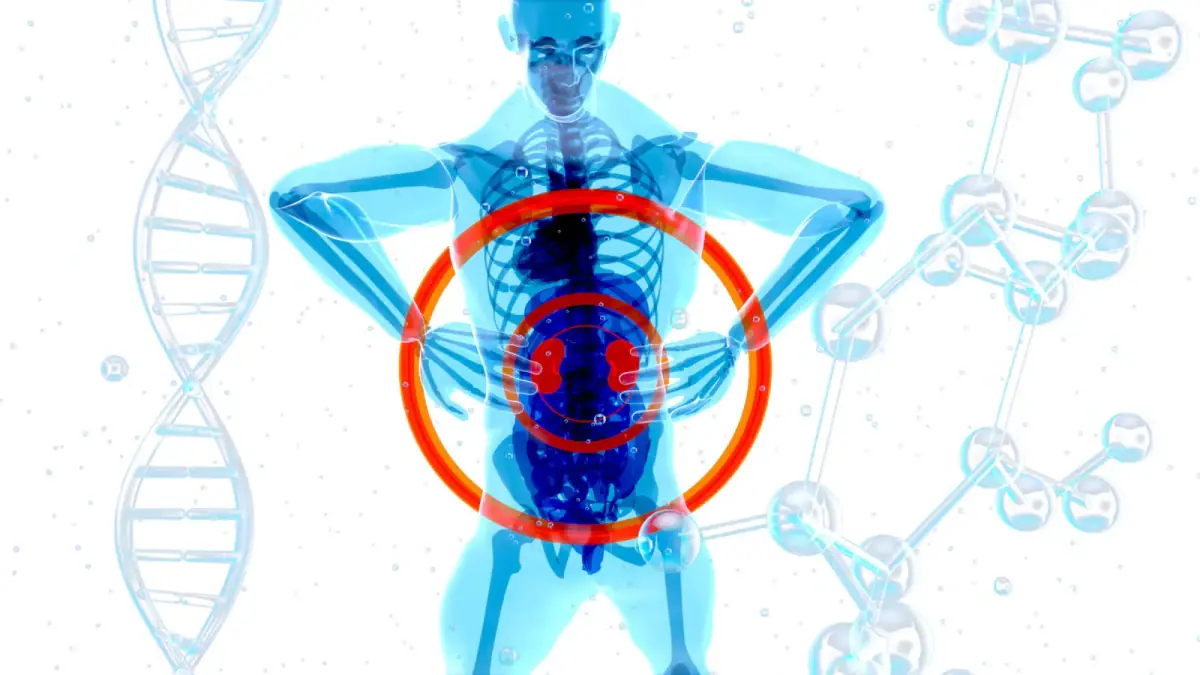
The human excretory system is a pair of kidneys, a pair of ureters, a urinary bladder and a urethra. Each kidney is a reddish brown, bean shaped organ between the last thoracic and third lumbar vertebra, about 10 to 12 cm long, 5 to 7 cm wide, 2 to 3 cm thick and 120 to 170 g in weight.
Work from the outside in. The hilum is the notch on the inner concave surface where the ureter, blood vessels and nerves enter. Inside it lies the funnel shaped renal pelvis with projections called calyces. The kidney has an outer cortex and an inner medulla; the medulla forms medullary pyramids that project into the calyces, and the cortex dips between them as the columns of Bertini.
Each kidney has nearly one million nephrons, the functional units. A nephron has two parts:
- Glomerulus: a tuft of capillaries formed by the afferent arteriole, a fine branch of the renal artery. Blood leaves through the efferent arteriole.
- Bowman's capsule: a double walled cup around the glomerulus. Together they form the Malpighian body, or renal corpuscle.
- Proximal convoluted tubule (PCT): the highly coiled part that follows.
- Henle's loop: hairpin shaped, with a descending and an ascending limb.
- Distal convoluted tubule (DCT): coiled again; many DCTs open into one collecting duct, which opens into the renal pelvis through the medullary pyramids.
The Malpighian corpuscle, PCT and DCT sit in the cortex; Henle's loop dips into the medulla. Most nephrons are cortical nephrons with a short loop. Juxta medullary nephrons have a very long loop that runs deep into the medulla. The efferent arteriole forms peritubular capillaries, and one minute vessel runs parallel to Henle's loop as the U shaped vasa recta, which is absent or highly reduced in cortical nephrons.
How is urine formed in three steps?
Urine formation in NCERT has three steps: glomerular filtration, reabsorption and secretion. Filtration pushes almost everything in plasma except proteins into Bowman's capsule. Reabsorption returns nearly 99 percent of that filtrate to the blood. Secretion adds H+, K+ and ammonia to keep the ionic and acid-base balance.
- Glomerular filtration. On average 1100 to 1200 ml of blood is filtered per minute, roughly one fifth of what each ventricle pumps. Glomerular capillary blood pressure drives it through three layers: the endothelium, the epithelium of Bowman's capsule (podocytes with filtration slits) and the basement membrane between them. Because proteins stay behind, it is called ultra filtration.
- Reabsorption. GFR is about 125 ml per minute, or 180 litres a day, while only about 1.5 litres of urine is released. So nearly 99 percent is reabsorbed. Glucose, amino acids and Na+ go back actively; nitrogenous wastes go back passively.
- Secretion. Tubular cells secrete H+, K+ and ammonia into the filtrate, which keeps the ionic and acid-base balance of body fluids.
GFR has its own regulator, the juxta glomerular apparatus (JGA). It is a sensitive region where the DCT and the afferent arteriole touch. When GFR falls, JG cells release renin, which brings glomerular blood flow and GFR back to normal.
What does each part of the nephron do?
Each part of the nephron has a fixed job, and NEET options are built by swapping them. The PCT reabsorbs the most, Henle's loop builds the medullary gradient, the DCT does conditional reabsorption of Na+ and water, and the collecting duct can reabsorb large amounts of water to make concentrated urine.
| Segment | Lining or permeability | Main job in NCERT |
|---|---|---|
| PCT | Simple cuboidal brush border epithelium | Reabsorbs nearly all essential nutrients and 70 to 80 percent of electrolytes and water; secretes H+ and ammonia, absorbs HCO3- |
| Descending limb of Henle's loop | Permeable to water, almost impermeable to electrolytes | Filtrate gets concentrated as it moves down |
| Ascending limb of Henle's loop | Impermeable to water, transports electrolytes | Filtrate gets diluted as it moves up; minimum reabsorption |
| DCT | Conditional reabsorption | Na+ and water; HCO3- reabsorption; secretes H+, K+ and NH3 |
| Collecting duct | Cortex to inner medulla | Large water reabsorption for concentrated urine; passes small amounts of urea to the interstitium; secretes H+ and K+ |
Counter current mechanism: from 300 to 1200
This is the hardest section of excretory products and their elimination for most students. Mammals can make concentrated urine because of Henle's loop and the vasa recta. Filtrate flows in opposite directions in the two limbs of the loop, and blood flows in opposite directions in the two limbs of the vasa recta. That is the counter current.
The arrangement keeps the medullary interstitium at rising osmolarity, from 300 mOsmol per litre in the cortex to about 1200 mOsmol per litre in the inner medulla. NCERT names NaCl and urea as the two solutes behind the gradient. NaCl leaves the ascending limb of the loop, is exchanged with the descending limb of the vasa recta and returned to the interstitium by the ascending vasa recta. Small amounts of urea enter the thin ascending limb and are carried back to the interstitium by the collecting tubule.
Water then leaves the collecting tubule easily into this salty interstitium, and the urine ends up nearly four times as concentrated as the initial filtrate. If you can draw Figure 16.6 with the arrows in the right direction, most counter current questions answer themselves.
Regulation of kidney function: ADH, renin and ANF
Three feedback systems control the kidney: the hypothalamus through ADH, the JGA through renin, and the heart through ANF. Put them in one table and the direction of each arrow is easier to keep straight.
| Signal | Trigger | Effect on the kidney |
|---|---|---|
| ADH (vasopressin) | Excess fluid loss activates osmoreceptors; hypothalamus releases ADH from the neurohypophysis | More water reabsorbed from the later parts of the tubule, so less diuresis; also constricts vessels, raising blood pressure and GFR |
| Renin-angiotensin | Fall in glomerular blood flow, pressure or GFR activates JG cells | Renin turns angiotensinogen into angiotensin I and then II; angiotensin II constricts vessels and makes the adrenal cortex release aldosterone, which reabsorbs Na+ and water in distal parts |
| ANF | More blood flow to the atria of the heart | Vasodilation and lower blood pressure; a check on the renin-angiotensin mechanism |
Learn excretory products and their elimination together with Chapter 18 for the hypothalamus and Chapter 19 for ADH, aldosterone and diabetes insipidus. Our neural control and coordination guide covers the hypothalamus side, and the body fluids and circulation guide covers the heart and blood pressure ideas that GFR leans on.
Micturition, other organs and disorders
Urine is stored in the urinary bladder until the CNS gives a voluntary signal. Stretch receptors in the bladder wall signal the CNS, which makes the bladder's smooth muscle contract and the urethral sphincter relax. That is the micturition reflex. NCERT's numbers for urine: 1 to 1.5 litres a day, light yellow, slightly acidic at pH 6.0, with 25 to 30 g of urea excreted a day. Glucose (glycosuria) and ketone bodies (ketonuria) in urine point to diabetes mellitus.
Other organs help too. The lungs remove about 200 ml of CO2 a minute plus water. The liver secretes bilirubin, biliverdin, cholesterol, degraded steroid hormones, vitamins and drugs in bile. Sweat carries NaCl, small amounts of urea and lactic acid; sebum carries sterols, hydrocarbons and waxes. Even saliva can remove small amounts of nitrogenous waste.
The disorders section closes excretory products and their elimination. It is short, but every term is examinable:
- Uremia: urea builds up in blood when the kidneys malfunction; it can lead to kidney failure.
- Hemodialysis: blood from an artery, with heparin added, passes through a coiled cellophane tube in dialysing fluid that matches plasma except for nitrogenous wastes, then returns through a vein with anti-heparin. The US National Institute of Diabetes and Digestive and Kidney Diseases describes [hemodialysis](https://www.niddk.nih.gov/health-information/kidney-disease/kidney-failure/hemodialysis) as a treatment to filter wastes and water from the blood, and notes the dialyzer is sometimes called an artificial kidney.
- Kidney transplantation: the ultimate method for acute renal failure, preferably from a close relative to minimise rejection.
- Renal calculi: stones of crystallised salts such as oxalates inside the kidney.
- Glomerulonephritis: inflammation of the glomeruli.
If this is the chapter that made you curious about kidneys as a career, our nephrologist route guide starts from exactly these pages.
Ten traps in excretory products and their elimination
Most wrong answers in excretory products and their elimination come from one swapped limb, hormone or number. Check these before you mark.
- Which limb is permeable to water. Descending yes, ascending no. NCERT's own fill-in-the-blank exercise asks exactly this.
- ADH makes urine concentrated. The exercise statement "ADH helps in water elimination, making the urine hypotonic" is false.
- Proteins are not filtered. "Protein-free fluid is filtered from blood plasma into the Bowman's capsule" is true.
- Glucose is reabsorbed actively in the PCT. Nitrogenous wastes go back passively.
- GFR versus blood filtered. 125 ml per minute is the filtrate; 1100 to 1200 ml per minute is the blood passing through.
- Vasa recta is absent or highly reduced in cortical nephrons. It belongs with juxta medullary nephrons.
- Amphioxus has flame cells. A chordate with protonephridia.
- Marine fishes are ureotelic. Many bony fishes are ammonotelic; do not lump all fish together.
- ANF lowers blood pressure. It checks the renin-angiotensin mechanism, it does not join it.
- "Nearly one million" and "over a million". NCERT uses both for nephrons per kidney (section 16.1 and the summary). Read the option, not the number alone.
A wrong answer costs one mark, so an option you cannot place with confidence is often better left blank. Our guide to NEET negative marking explains when skipping pays.
How should you revise excretory products and their elimination?
Two focused days are enough to revise excretory products and their elimination. Day one covers modes of excretion, kidney structure and the three steps of urine formation. Day two covers the tubule table, the counter current mechanism, the three hormone systems and the disorders, then timed questions. Redraw the nephron a week later.
- Day 1, morning: read the opening pages and 16.1 in the NCERT PDF, fill the three-mode table from memory and draw Figures 16.2 and 16.3.
- Day 1, afternoon: read 16.2 and write the three steps with GFR, 180 litres, 1.5 litres and 99 percent beside them.
- Day 1, evening: read 16.3 and rebuild the segment table above without looking.
- Day 2, morning: read 16.4 and draw Figure 16.6 with every arrow and the 300 and 1200 labels.
- Day 2, afternoon: read 16.5 to 16.8 and section 19.2.2 of Chapter 19, then fill the ADH, renin and ANF table.
- Day 2, evening: 30 timed MCQs, each mistake tagged with a trap number, then the twelve NCERT exercises.
- One week later: redraw the nephron and the counter current figure in ten minutes and repeat only the mistakes.
For practice, start with our NEET Biology MCQ guide, and for figures, the NEET Biology diagrams guide lists the six figures of this chapter.
On futureMBBS you will find the NEET 2027 Biology syllabus laid out unit by unit, a NEET 2027 chapter-wise weightage guide that shows where Human Physiology stands, and a look at how to become a nephrologist if the kidney is where your interest lies.
If excretory products and their elimination is where your Zoology marks slip, NEETsheet's chapter-wise practice and timed mocks show whether the gap is the nephron, the counter current or the hormones, so your next hour goes to the right place. Start at neetsheet.in.
Sources
All links were checked on 20 November 2026.
- NCERT, Biology Class 11, Chapter 16 Excretory Products and their Elimination, reprint 2026-27 (pages 205 to 216; sections 16.1 to 16.8; Figures 16.1 to 16.6; Summary; twelve exercises): https://ncert.nic.in/textbook/pdf/kebo116.pdf
- NCERT, Biology Class 11, Chapter 19 Chemical Coordination and Integration, reprint 2026-27 (section 19.2.2, page 242, ADH and diabetes insipidus): https://ncert.nic.in/textbook/pdf/kebo119.pdf
- National Medical Commission (UGMEB), Syllabus for NEET (UG) 2026, public notice of 22 December 2025 (Biology Unit 5, Human Physiology, third bullet): https://cdnbbsr.s3waas.gov.in/s37bc1ec1d9c3426357e69acd5bf320061/uploads/2026/01/202601081066816297.pdf
- National Testing Agency, Information Bulletin NEET (UG) 2026 (180 questions in 180 minutes; Biology 90 questions and 360 of 720 marks; plus four for a correct answer, minus one for an incorrect one): https://cdnbbsr.s3waas.gov.in/s37bc1ec1d9c3426357e69acd5bf320061/uploads/2026/02/202602231394640855.pdf
- National Testing Agency, NEET (UG) official website (no NEET (UG) 2027 notice on 20 November 2026): https://neet.nta.nic.in/
- National Institute of Diabetes and Digestive and Kidney Diseases (NIH), Hemodialysis, last reviewed January 2018: https://www.niddk.nih.gov/health-information/kidney-disease/kidney-failure/hemodialysis
Frequently Asked Questions
Five excretory products named in NCERT Chapter 16 are ammonia, urea, uric acid, carbon dioxide and water. Animals also eliminate ions such as Na+, K+, Cl-, phosphate and sulphate. Ammonia, urea and uric acid are the major nitrogenous wastes, from most toxic to least toxic.
The three steps of urine formation are glomerular filtration in the glomerulus, reabsorption by the renal tubules, and tubular secretion of substances such as H+, K+ and ammonia. Filtration forms about 180 litres of filtrate a day, and nearly 99 percent of it is reabsorbed.
The counter current mechanism is the opposite flow of filtrate in the two limbs of Henle's loop and of blood in the two limbs of the vasa recta. It keeps the medullary interstitium at 300 to about 1200 mOsmol per litre, mainly with NaCl and urea, so urine can be concentrated about four times.
Diabetes insipidus is linked to ADH, also called vasopressin. NCERT Chapter 19 says an impairment in ADH synthesis or release reduces the kidney's ability to conserve water, causing water loss and dehydration. The NEET syllabus lists it under regulation of kidney function, but Chapter 16 itself does not name it.
The NEET (UG) 2027 syllabus was not published on 20 November 2026. In the NMC syllabus for NEET (UG) 2026, excretory products and their elimination is the third bullet of Unit 5, Human Physiology, covering modes of excretion, urine formation, kidney regulation, other organs, disorders and dialysis.