
Morphology of Flowering Plants for NEET: Chapter 5 Guide
Morphology of flowering plants is Chapter 5 of NCERT Class 11 Biology, and for NEET it is the opening topic of Unit 2, Structural Organisation in Animals and Plants. It is the study of the external form of an angiosperm: root, stem, leaf, inflorescence, flower, fruit and seed. This guide maps morphology of flowering plants to the NMC syllabus line by line, answers the "five families" question properly and lists the traps that cost marks.
What is morphology of flowering plants?
Morphology of flowering plants is the description of the external structure of angiosperms, using standard technical terms. NCERT says every flowering plant, however varied, has roots, stems, leaves, flowers and fruits. The chapter teaches the vocabulary to describe each part, so that a plant can be classified and identified.
The NCERT Chapter 5 PDF (reprint 2026-27) runs through nine sections in a fixed order: 5.1 The Root, 5.2 The Stem, 5.3 The Leaf, 5.4 The Inflorescence, 5.5 The Flower, 5.6 The Fruit, 5.7 The Seed, 5.8 Semi-technical Description of a Typical Flowering Plant, and 5.9 Solanaceae. It ends on page 70 with ten exercises.
The plant body has two systems. The underground part is the root system. The part above the ground is the shoot system: stem, leaves, flowers and fruits. That split is the whole chapter in one sentence.
Morphology of flowering plants is a vocabulary chapter more than a concept chapter. There is very little to "understand" and a great deal to recognise on sight: hypogynous, epipetalous, diadelphous, vexillary, free central. NEET options are built by swapping one of these words or one example plant. So the work is precise memory, not long reading.
Is morphology of flowering plants important for NEET?
Yes. Morphology of flowering plants is a named topic of Unit 2 in the NMC syllabus for NEET (UG) 2026, and the syllabus marks it for practical-style study, so expect specimen and diagram questions. NTA does not publish chapter-wise question counts, so no honest source can give you a number. Biology carries 90 of the 180 questions.
The NMC syllabus for NEET (UG) 2026, sent to all medical colleges on 22 December 2025, puts this chapter in the first bullet of Unit 2. It lists morphology and modifications, tissues, and the anatomy and functions of root, stem, leaf, inflorescence (cymose and racemose), flower, fruit and seed, with the note "to be dealt along with the relevant practical of the Practical Syllabus". It then names five families.
The NEET (UG) 2026 information bulletin fixes the paper: 180 compulsory questions in 180 minutes, four marks for a right answer, minus one for a wrong one. Biology (Botany and Zoology) is 90 questions and 360 marks, exactly 50 percent of the paper.
So morphology of flowering plants is one of the few Botany chapters that the syllabus ties to the practical work. That is why people search "is morphology of flowering plants important for NEET" so often. The honest answer: it is in the syllabus, it is short, and its examples are easy to turn into options. Our NEET Biology syllabus guide shows where Unit 2 sits among all ten units.
What are the 5 families in morphology of flowering plants?
The 5 families are Malvaceae, Cruciferae, Leguminosae, Compositae and Gramineae. They are the five the NMC syllabus for NEET (UG) 2026 names at the end of the Unit 2 morphology bullet. The current NCERT chapter does not describe any of them in full. Its only family description is Solanaceae, the potato family.
This is the single most useful thing to know about the chapter, and it is easy to get wrong. Here is what each official document actually says.
| Document | Families it covers | How |
|---|---|---|
| NMC syllabus for NEET (UG) 2026, Unit 2 | Malvaceae, Cruciferae, Leguminosae, Compositae, Gramineae | Named in brackets, "to be dealt along with the relevant practical of the Practical Syllabus" |
| NCERT Class 11, Chapter 5, section 5.9 (reprint 2026-27) | Solanaceae | Full semi-technical description, floral formula and economic importance |
| NCERT Class 11, Chapter 5, Figure 5.16 | Brassicaceae (mustard) | Floral diagram and floral formula only, no family description |
Three points follow.
First, the syllabus uses old descriptive names. The botanical Code, Article 18.5, treats these "names of long usage" as valid alongside the regular ones: Gramineae is Poaceae, Cruciferae is Brassicaceae, Leguminosae is Fabaceae, and Compositae is Asteraceae. Malvaceae already has the regular ending. So the mustard in Figure 5.16, which NCERT labels Brassicaceae, is a Cruciferae plant.
Second, the syllabus prints the names as "malvaceae, Cruciferae, leguminoceae, compositae, graminae". The spellings in an exam option will be the standard ones. Don't let a spelling throw you.
Third, Solanaceae is the family you can actually study from the textbook. It is not on the syllabus list, but it is the worked example of how any family is described. Learn it as the template, then fill the same template for the five named families from your practical work.
| Family named in the syllabus | Regular name under Article 18.5 | What the current chapter says about it |
|---|---|---|
| Malvaceae | Malvaceae | Not named anywhere in Chapter 5 |
| Cruciferae | Brassicaceae | Mustard, labelled Brassicaceae: floral diagram and formula in Figure 5.16 |
| Leguminosae | Fabaceae | One line: in some leguminous plants the swollen leaf base is the pulvinus |
| Compositae | Asteraceae | Not named anywhere in Chapter 5 |
| Gramineae | Poaceae | Not named anywhere in Chapter 5 |
The right-hand column is only what NCERT prints, nothing added. NCERT uses many plants as examples (china rose, pea, sunflower, wheat, maize) but never says which family they belong to, so do not take a family name for them from this chapter alone. That is exactly the gap your practical record has to fill.
How does the syllabus line map to NCERT?
Every phrase of the morphology of flowering plants syllabus has a home in the chapter, except one. Use this table as your checklist.
| NMC syllabus phrase | Where NCERT teaches it | What to be able to write |
|---|---|---|
| Morphology of root | 5.1, 5.1.1 | Tap, fibrous, adventitious roots; four regions of the root tip |
| Stem | 5.2 | Nodes, internodes, terminal and axillary buds; functions |
| Leaf | 5.3 to 5.3.3 | Parts, venation, simple and compound, phyllotaxy |
| Inflorescence, cymose and racemose | 5.4 | Growth of the main axis and order of flowers |
| Flower | 5.5 to 5.5.1.4 | Symmetry, ovary position, aestivation, androecium, placentation |
| Fruit and seed | 5.6, 5.7 | Drupe, pericarp layers; dicot and monocot seed |
| Families | 5.8, 5.9 | Floral formula symbols; Solanaceae as the template |
| Modifications | Summary only | See the next section |
Are root, stem and leaf modifications still in the chapter?
No, not in the body. The 2026-27 reprint of Chapter 5 has no section on modifications of root, stem or leaf. Section 5.1 covers root types and the regions of the root tip and goes straight to the stem. Yet the syllabus still says "morphology and modifications", and the chapter summary still says roots in some plants get modified for storage, support and respiration.
That leaves a small, real gap between the two documents. Here is how to handle it without wasting time.
Learn exactly what the summary states: roots may be modified for storage of food, mechanical support and respiration. That sentence is in the current book, so it is fair game. Beyond it, NCERT's present text gives you no named examples, no pneumatophores, no tendrils, no phylloclades. An old question bank that asks about them is working from an older edition of the book.
If you want the full picture of what was removed from Class 11 and Class 12 Biology, our NEET 2027 deleted syllabus guide lists it chapter by chapter. And remember the rule the NEET (UG) 2026 bulletin states plainly: the syllabus is the one NMC notified, so the NMC line, not a coaching list, decides what is in scope.
Root, stem and leaf in the current chapter
The vegetative part of morphology of flowering plants is short. Learn these facts word for word, because each one is an option waiting to be swapped.
Root. In most dicots the radicle grows into a primary root with secondary and tertiary branches: the tap root system, as in mustard. In monocots the primary root is short lived and replaced by many roots from the base of the stem: the fibrous root system, as in wheat. Roots that arise from any part other than the radicle are adventitious, as in grass, Monstera and the banyan tree. The root tip has four regions from the apex up: root cap, region of meristematic activity, region of elongation and region of maturation, where some epidermal cells form root hairs.
Stem. The stem develops from the plumule. It bears nodes, where leaves are borne, and internodes between them, with terminal or axillary buds.
Leaf. A typical leaf has a leaf base, a petiole and a lamina, and may have two stipules. In monocots the leaf base expands into a sheath. In some leguminous plants the swollen leaf base is called the pulvinus.
| Leaf feature | Type | NCERT example |
|---|---|---|
| Venation | Reticulate (veinlets form a network) | Most dicots |
| Venation | Parallel (veins run parallel) | Most monocots |
| Compound leaf | Pinnately compound (leaflets on a rachis) | Neem |
| Compound leaf | Palmately compound (leaflets at the tip of the petiole) | Silk cotton |
| Phyllotaxy | Alternate (one leaf per node) | China rose, mustard, sunflower |
| Phyllotaxy | Opposite (a pair per node) | Calotropis, guava |
| Phyllotaxy | Whorled (more than two per node) | Alstonia |
One line people miss: a bud sits in the axil of the petiole of both simple and compound leaves, but never in the axil of a leaflet. That is how you tell a compound leaf from a twig with leaves.
How do racemose and cymose inflorescence differ?
Racemose and cymose inflorescence differ in what happens to the main axis. In racemose, the main axis keeps growing and flowers are borne laterally in acropetal succession, the oldest at the base. In cymose, the main axis ends in a flower, so growth is limited, and flowers are borne in basipetal order, the oldest at the top.
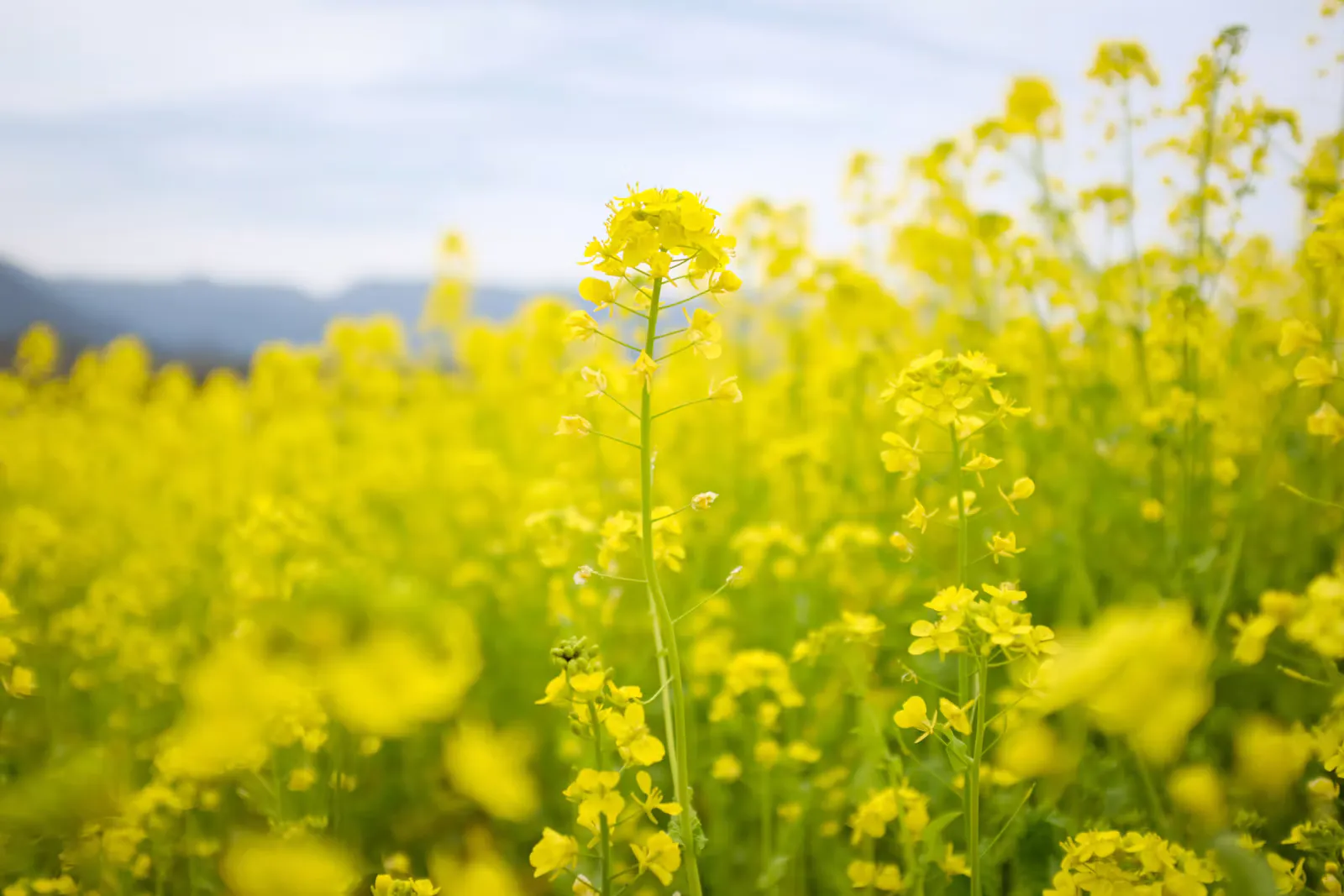
The photo shows the racemose pattern at a glance: open flowers lower on each stalk, younger buds at the growing tip.
NCERT also defines the flower itself as a modified shoot, where the shoot apical meristem turns into a floral meristem, internodes do not elongate and the axis gets condensed. When a shoot tip turns into a flower, it is always solitary. That sentence answers the occasional "flower is a modified..." question directly.
| Racemose | Cymose | |
|---|---|---|
| Main axis | Continues to grow | Terminates in a flower |
| Order of flowers | Acropetal (oldest at the base) | Basipetal (oldest at the tip) |
| NCERT figure | 5.7 | 5.8 |
What are the parts of a flower, and how are they described?
A flower has four whorls on the thalamus (receptacle): calyx, corolla, androecium and gynoecium. Calyx and corolla are accessory organs; androecium and gynoecium are reproductive. NEET questions then describe the flower by symmetry, ovary position, aestivation, stamen arrangement and placentation, each with fixed NCERT examples.
When calyx and corolla cannot be told apart, as in lily, they are called the perianth. A flower with both androecium and gynoecium is bisexual; one with only stamens or only carpels is unisexual. Flowers with bracts at the base of the pedicel are bracteate; those without are ebracteate.
Symmetry. Actinomorphic flowers can be split into two equal halves through any radial plane: mustard, datura, chilli. Zygomorphic flowers split into two similar halves in only one vertical plane: pea, gulmohur, bean, Cassia. Asymmetric flowers cannot be split at all: canna.
Position of the ovary.
| Flower type | Ovary | NCERT examples |
|---|---|---|
| Hypogynous | Superior | Mustard, china rose, brinjal |
| Perigynous | Half inferior | Plum, rose, peach |
| Epigynous | Inferior | Guava, cucumber, ray florets of sunflower |
Aestivation is the way sepals or petals are arranged in the bud.
| Aestivation | What happens | NCERT examples |
|---|---|---|
| Valvate | Margins just touch, no overlap | Calotropis |
| Twisted | Each margin overlaps the next in one direction | China rose, lady's finger, cotton |
| Imbricate | Margins overlap in no fixed direction | Cassia, gulmohur |
| Vexillary (papilionaceous) | Standard overlaps two wings, which overlap two keel petals | Pea, bean |
Androecium. A sterile stamen is a staminode. Stamens attached to petals are epipetalous (brinjal); attached to the perianth, epiphyllous (lily). Free stamens are polyandrous. United into one bundle they are monoadelphous (china rose), two bundles diadelphous (pea), more than two polyadelphous (citrus). Filament length varies within one flower in Salvia and mustard.
Gynoecium. Each carpel has stigma, style and ovary. Free carpels are apocarpous (lotus, rose); fused carpels are syncarpous (mustard, tomato).
Placentation is the arrangement of ovules inside the ovary. Here is the one trap in the wording: the NCERT sentence lists "marginal, axile, parietal, basal, central and free central", six names, but Figure 5.12 shows five types and the text describes five. Learn the five.
| Placentation | Key feature | NCERT examples |
|---|---|---|
| Marginal | Ridge along the ventral suture, ovules in two rows | Pea |
| Axile | Axial placenta in a multilocular ovary | China rose, tomato, lemon |
| Parietal | Ovules on the inner wall; one chamber made two by a false septum | Mustard, Argemone |
| Free central | Ovules on a central axis, no septa | Dianthus, Primrose |
| Basal | Placenta at the base, a single ovule | Sunflower, marigold |
The flower diagrams in this chapter are among the most labelled figures in Class 11 Botany. Our NEET Biology diagrams guide tells you which ones to draw from memory and which only to label on sight.
Fruit and seed in four facts
A fruit is a mature or ripened ovary, developed after fertilisation, and a seed is a fertilised ovule. Four facts carry most of the questions.
- Parthenocarpic fruit forms without fertilisation of the ovary.
- Pericarp layers. A thick, fleshy pericarp is epicarp, mesocarp and endocarp. Mango and coconut are drupes, from monocarpellary superior ovaries, one seeded. Mango has a fleshy edible mesocarp and a stony endocarp; in coconut the mesocarp is fibrous.
- Dicot seed. Seed coat of testa and tegmen, a hilum scar, a micropyle above it, and an embryo of embryonal axis plus two cotyledons. Castor is endospermic; bean, gram and pea are non-endospermous.
- Monocot seed. Generally endospermic, but orchids are not. In maize the aleurone layer separates the endosperm from the embryo, the single cotyledon is the scutellum, and the plumule and radicle sit in the coleoptile and coleorhiza.
The seed is also where this chapter meets Class 12. Double fertilisation, endosperm formation and embryo development are explained in our sexual reproduction in flowering plants guide, and the two chapters make a strong revision pair.
How do you read a floral formula?
A floral formula is a one-line summary of a flower using symbols. In it, Br is bracteate, K is calyx, C is corolla, P is perianth, A is androecium and G is gynoecium, with a mark on G for a superior or inferior ovary. Brackets show fusion within a whorl. The symbol ⊕ means actinomorphic.
NCERT's worked example is mustard, Family Brassicaceae, in Figure 5.16: ⊕ K2+2 C4 A2+4 G(2). Read it left to right: actinomorphic; four sepals in two whorls of two; four petals; six stamens in two whorls of two and four; two fused carpels in a superior ovary. That is 16 floral parts in total, and the chart shows how they split.
The other formula in the chapter is Solanaceae. Learn its description as the model answer for any family question.
| Solanaceae feature | NCERT description |
|---|---|
| Common name | Potato family; example Solanum nigrum (makoi) |
| Habit and leaves | Mostly herbs or shrubs; leaves alternate, simple, rarely pinnately compound, exstipulate, reticulate |
| Inflorescence and flower | Solitary, axillary or cymose; bisexual, actinomorphic |
| Calyx and corolla | Five united sepals, persistent, valvate; five united petals, valvate |
| Androecium | Five stamens, epipetalous |
| Gynoecium | Bicarpellary, obliquely placed, syncarpous, superior, bilocular, swollen placenta, axile |
| Fruit and seed | Berry or capsule; many endospermous seeds |
| Economic importance | Food (tomato, brinjal, potato), spice (chilli), medicine (belladonna, ashwagandha), fumigatory (tobacco), ornamental (petunia) |
Ten traps in morphology of flowering plants questions
These are the swaps that turn a known fact into a wrong option:
- Families. The syllabus names Malvaceae, Cruciferae, Leguminosae, Compositae and Gramineae. Solanaceae is the NCERT family, not a syllabus one.
- Old and new names. Cruciferae is Brassicaceae, Leguminosae is Fabaceae, Compositae is Asteraceae, Gramineae is Poaceae. An option may use either.
- Acropetal versus basipetal. Racemose is acropetal, cymose is basipetal. Not the other way round.
- Superior ovary. Hypogynous flowers (mustard, china rose, brinjal) have a superior ovary; epigynous flowers (guava, cucumber) have an inferior one.
- Perigynous examples. Plum, rose and peach, with a half inferior ovary.
- Twisted versus imbricate. China rose, lady's finger and cotton are twisted; Cassia and gulmohur are imbricate.
- Stamen bundles. China rose one bundle, pea two, citrus more than two.
- Parietal placentation. Mustard and Argemone, with a false septum. Not tomato, which is axile.
- Endospermic seeds. Castor is endospermic; bean, gram and pea are not. Orchid seeds are the monocot exception.
- Coconut. A drupe with a fibrous mesocarp, from a monocarpellary superior ovary.
How should you revise morphology of flowering plants?
Two focused days are enough for morphology of flowering plants if you work from the book and test yourself the same day. Spend day one on the vegetative parts and the flower, day two on fruit, seed and families, and close each day with timed questions.
- Day 1, morning: read 5.1 to 5.4 in the NCERT PDF. Fill the leaf table above from memory and draw racemose and cymose side by side.
- Day 1, afternoon: read 5.5. Make one flashcard per table row: ovary position, aestivation, stamen bundles, placentation, each with its examples.
- Day 1, evening: 30 timed MCQs on the flower. Mark every wrong answer with the trap number it fell into.
- Day 2, morning: read 5.6 to 5.9. Draw the gram seed and the V.S. of maize seed, as NCERT's exercise 5 asks.
- Day 2, afternoon: write the Solanaceae description from memory, then build the same table for Malvaceae, Cruciferae, Leguminosae, Compositae and Gramineae from your practical record.
- Day 2, evening: answer the ten NCERT exercises in two or three lines each, then one week later a 15-question recall test.
Negative marking matters here, because one swapped example makes an option wrong. Our guide to NEET negative marking shows when skipping is the smarter move. For practice sets, start with our NEET Biology MCQ guide, and if you want the chapter before this one, our plant kingdom guide ends where the angiosperm story begins.
For the wider picture, futureMBBS has a full NEET syllabus guide covering all three subjects, a NEET 2027 chapter-wise weightage guide that shows where Structural Organisation stands, and a short read on what an NCERT book is if you are deciding how far beyond the textbook to go for the five families.
If morphology of flowering plants is where your Botany marks keep slipping, NEETsheet's chapter-wise practice and timed mocks show whether the gap is aestivation, placentation or the families, so your next hour goes to the right place. Start at neetsheet.in.
Sources
All links were checked on 16 November 2026.
- National Medical Commission (UGMEB), Syllabus for NEET (UG) 2026, letter and public notice of 22 December 2025 (Biology Unit 2, Structural Organisation in Animals and Plants: morphology and modifications; root, stem, leaf, inflorescence cymose and racemose, flower, fruit and seed, to be dealt along with the relevant practical of the Practical Syllabus; families malvaceae, Cruciferae, leguminoceae, compositae, graminae): https://cdnbbsr.s3waas.gov.in/s37bc1ec1d9c3426357e69acd5bf320061/uploads/2026/01/202601081066816297.pdf
- National Testing Agency, Information Bulletin NEET (UG) 2026 (syllabus notified by NMC; pattern: Physics 45 questions and 180 marks, Chemistry 45 and 180, Biology 90 and 360, total 180 and 720; plus four, minus one and zero marking): https://cdnbbsr.s3waas.gov.in/s37bc1ec1d9c3426357e69acd5bf320061/uploads/2026/02/202602231394640855.pdf
- NCERT, Biology Class 11, Chapter 5 Morphology of Flowering Plants, reprint 2026-27 (sections 5.1 to 5.9, Figures 5.1 to 5.17, Summary and Exercises): https://ncert.nic.in/textbook/pdf/kebo105.pdf
- International Code of Botanical Nomenclature (Tokyo Code), Article 18.5, hosted by the University of Hamburg (Gramineae (Poaceae), Cruciferae (Brassicaceae), Leguminosae (Fabaceae), Compositae (Asteraceae) as names of long usage): https://www-archiv.fdm.uni-hamburg.de/b-online/code/Art_18.htm
Frequently Asked Questions
The 5 families are Malvaceae, Cruciferae, Leguminosae, Compositae and Gramineae, named in Unit 2 of the NMC syllabus for NEET (UG) 2026 for study with the practical syllabus. The current NCERT Chapter 5 describes only Solanaceae in full and uses mustard (Brassicaceae, the same family as Cruciferae) for its floral formula.
Yes. Morphology of flowering plants is a named topic of Unit 2, Structural Organisation in Animals and Plants, in the NMC syllabus for NEET (UG) 2026, covering root, stem, leaf, inflorescence, flower, fruit, seed and five families. NTA does not publish chapter-wise question counts, but Biology carries 90 of the 180 questions.
NTA does not publish chapter-wise question counts, so there is no official number for morphology of flowering plants. What is official is the weight of the subject: Biology carries 90 of the 180 questions and 360 of the 720 marks in the NEET (UG) 2026 pattern, and Structural Organisation is one of its ten units.
Mostly, yes. NCERT Chapter 5 covers every syllabus item from root to seed, with the examples NEET options use. Two gaps remain: the syllabus names five families that the chapter does not describe, and it says modifications, which the current chapter mentions only in its summary. Cover the families from your practical work.
Morphology of flowering plants is Chapter 5 of NCERT Class 11 Biology. It describes the external form of angiosperms in nine sections: root, stem, leaf, inflorescence, flower, fruit, seed, the semi-technical description of a plant with its floral formula, and the family Solanaceae. For NEET it belongs to Unit 2 of the syllabus.