
Anatomy of Flowering Plants for NEET: Chapter 6 Guide
Anatomy of flowering plants is Chapter 6 of NCERT Class 11 Biology, and for NEET it sits in Unit 2, Structural Organisation in Animals and Plants. It is the study of the internal structure of angiosperms: the three tissue systems, the types of vascular bundle, and the transverse sections of dicot and monocot roots, stems and leaves. This guide maps anatomy of flowering plants to the syllabus, settles the secondary growth question and lists the traps.
What is anatomy of flowering plants?
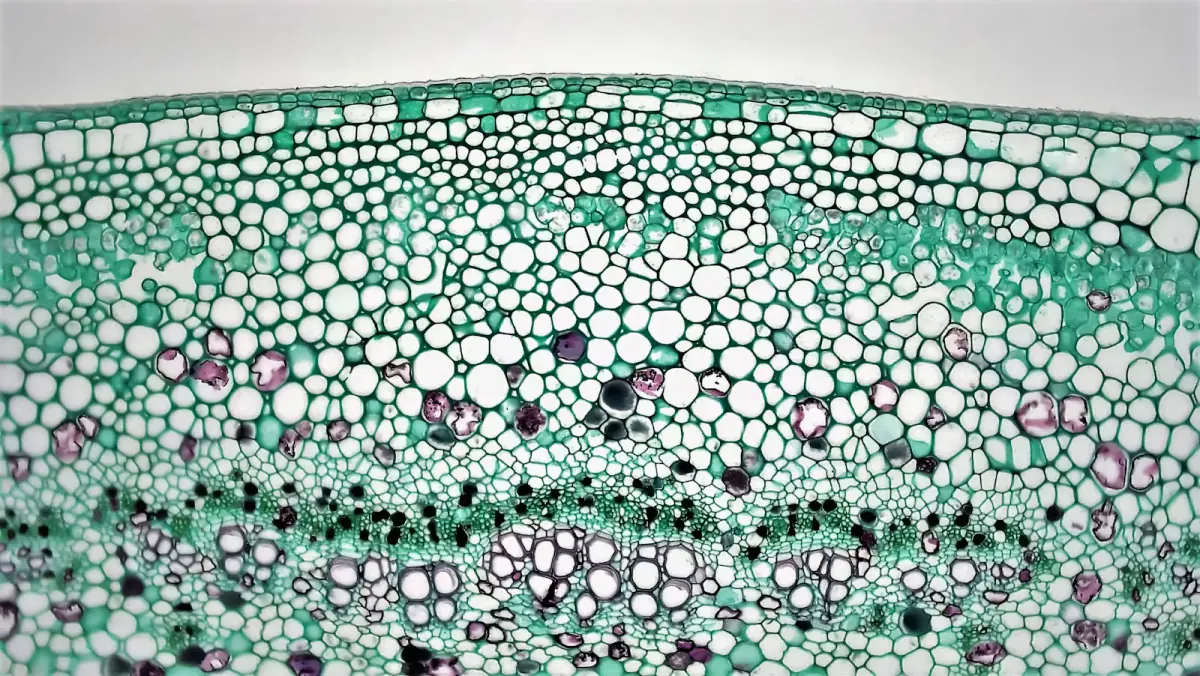
Anatomy of flowering plants is the study of the internal structure of angiosperms. NCERT defines anatomy as the study of internal structure and explains the logic in one line: cells form tissues, and tissues form organs. The chapter then compares the inside of dicot and monocot roots, stems and leaves, seen in transverse section.
The NCERT Chapter 6 PDF (reprint 2026-27) has only two sections. Section 6.1, The Tissue System, covers the epidermal, ground and vascular tissue systems. Section 6.2, Anatomy of Dicotyledonous and Monocotyledonous Plants, walks through six sections of plant organs: dicot root, monocot root, dicot stem, monocot stem, dorsiventral leaf and isobilateral leaf.
So where morphology describes what a plant looks like from outside, anatomy of flowering plants describes what you see when you cut it open and put a thin slice under a microscope. If you have not done the outside yet, our morphology of flowering plants guide covers Chapter 5, the chapter just before this one.
Is anatomy of flowering plants important for NEET?
Yes. Anatomy of flowering plants is part of the first bullet of Unit 2 in the NMC syllabus for NEET (UG) 2026, which lists tissues and the anatomy and functions of different parts of flowering plants. NTA does not publish chapter-wise question counts, so no honest source can give a number, but Biology carries 90 of the 180 questions.
The NMC syllabus for NEET (UG) 2026, sent to all medical colleges on 22 December 2025, reads: "Morphology and modifications; Tissues; Anatomy and functions of different parts of flowering plants". It adds that this part is "to be dealt along with the relevant practical of the Practical Syllabus". In plain words: expect diagram and slide questions, not only definitions.
The NEET (UG) 2026 information bulletin fixes the paper: 180 compulsory questions in 180 minutes, four marks for a correct answer and minus one for a wrong one. Biology (Botany and Zoology) has 90 questions worth 360 marks, which is 50 percent of the 720-mark paper. Our NEET Biology syllabus guide shows where Unit 2 sits among all ten units.
Is secondary growth deleted from anatomy of flowering plants?
The current NCERT chapter has no section on secondary growth, and the NMC syllabus line for NEET (UG) 2026 does not name it. That is the answer most students are looking for. But the topic has not vanished from the book: several sentences in the current anatomy of flowering plants chapter still refer to it.
Here is where secondary growth still appears in the 2026-27 reprint:
- Open bundles. Dicot stem bundles have cambium, so they "possess the ability to form secondary xylem and phloem tissues". That is why they are called open.
- Pericycle of the dicot root. Lateral roots and the vascular cambium for secondary growth start in these cells.
- Cambium ring. In the dicot root, a cambium ring later develops between xylem and phloem.
- Monocot root. It does not undergo any secondary growth.
- Summary. Secondary growth occurs in most dicotyledonous roots and stems.
The same pattern applies to tissue types. The chapter summary still classifies plant tissues as meristematic (apical, lateral and intercalary) and permanent (simple and complex), and the syllabus says "Tissues", but the body text no longer has a section on them. Learn that one-line classification from the summary. Our guide to the NEET 2027 deleted syllabus explains how to read changes like this across all of Biology. The NEET (UG) 2027 syllabus and bulletin were not yet published on neet.nta.nic.in on 18 November 2026, so recheck this when they are.
What are the three tissue systems?
The three tissue systems of a flowering plant are the epidermal, the ground and the vascular tissue system. NCERT groups tissues by structure and location: the epidermis covers the whole plant, the vascular system conducts water and food, and everything else between them is ground tissue, including cortex, pericycle and pith.
| Tissue system | What it is made of | Facts NEET options use |
|---|---|---|
| Epidermal | Epidermal cells, stomata, trichomes and hairs | Epidermis is usually single-layered; cuticle is absent in roots; root hairs are unicellular, shoot trichomes usually multicellular |
| Ground | Simple tissues: parenchyma, collenchyma, sclerenchyma | Includes cortex, pericycle, pith and medullary rays; in leaves it is the mesophyll |
| Vascular | Complex tissues: xylem and phloem | Xylem and phloem together form vascular bundles |
One small sentence carries a lot of weight: "All tissues except epidermis and vascular bundles constitute the ground tissue." If an option calls the pericycle part of the vascular system, or the mesophyll part of the epidermis, it is wrong.
Radial, conjoint, open and closed: the four bundle words
Vascular bundle questions are vocabulary questions. You need four words and one exception.
- Radial: xylem and phloem alternate on different radii. Found in roots.
- Conjoint: xylem and phloem lie together on the same radius. Common in stems and leaves, usually with phloem only on the outer side of xylem.
- Open: cambium is present between xylem and phloem, as in dicot stems.
- Closed: no cambium, so no secondary tissues form, as in monocots.
So a dicot stem bundle is conjoint and open, with endarch protoxylem. A monocot stem bundle is conjoint and closed. NCERT draws all three types in Figure 6.2: radial, conjoint closed and conjoint open. If you only memorise one figure from the chapter, make it this one, because the bundle type is the first thing to check in any section.
How do you tell a dicot from a monocot in a T.S.?
You tell a dicot from a monocot in a transverse section by the vascular bundles first: their number, their arrangement and whether they have cambium. Dicot roots have two to four xylem patches and monocot roots usually more than six. Dicot stems have bundles in a ring; monocot stems have many scattered, closed bundles.
The full comparison, line by line from sections 6.2.1 to 6.2.6:
| Feature | Dicot | Monocot |
|---|---|---|
| Root: xylem bundles | Usually two to four patches | Usually more than six (polyarch) |
| Root: pith | Small or inconspicuous | Large and well developed |
| Root: secondary growth | A cambium ring develops later | None |
| Stem: hypodermis | Collenchyma | Sclerenchyma |
| Stem: bundles | In a ring; conjoint, open, endarch | Scattered, each in a sclerenchymatous bundle sheath; conjoint, closed |
| Stem: other marks | Endodermis is the starch sheath; pericycle as semi-lunar sclerenchyma patches; medullary rays | Phloem parenchyma absent; water-containing cavities; peripheral bundles smaller than central ones |
| Leaf: type | Dorsiventral | Isobilateral |
| Leaf: stomata | More on the lower (abaxial) surface | On both surfaces |
| Leaf: mesophyll | Palisade (upper side) and spongy | Not differentiated |
| Leaf: veins | Reticulate; bundle size varies with vein size | Parallel; bundles of near similar size |
NCERT's example for the dicot root is the sunflower. Its endodermis is a single layer of barrel-shaped cells with suberin deposited as casparian strips, and everything inside the endodermis (pericycle, vascular bundles, pith) is the stele.
What do stomata and bulliform cells do?
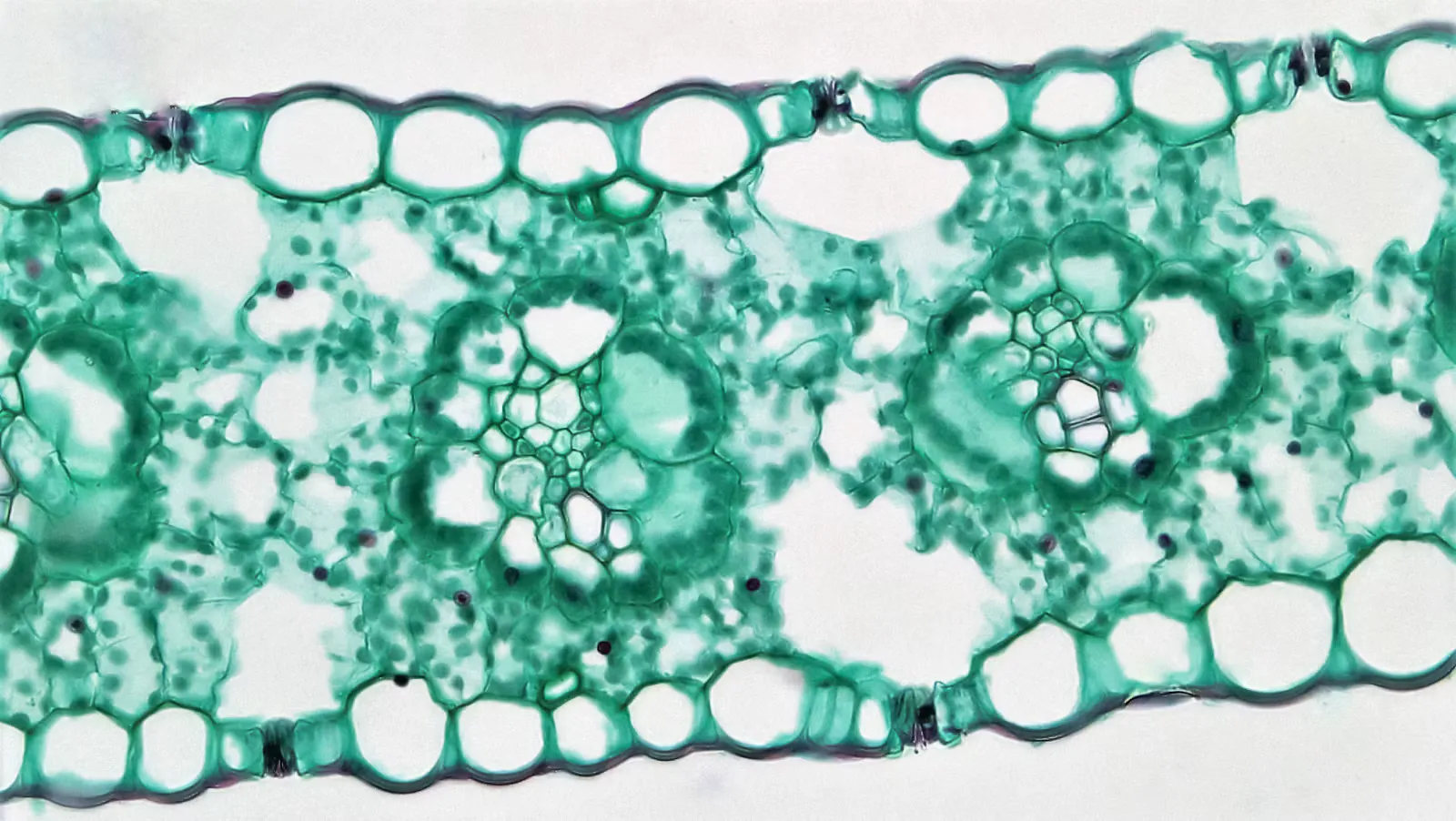
Stomata regulate transpiration and gaseous exchange, and bulliform cells let a grass leaf curl inwards to cut water loss. Both are epidermal structures. NEET options swap their shapes and positions: bean-shaped versus dumb-bell shaped guard cells, and the upper versus the lower surface of the leaf.
The details NCERT gives for stomata in section 6.1.1:
- Each stoma has two guard cells around a stomatal pore. They are bean-shaped in most plants and dumb-bell shaped in grasses.
- The outer walls of guard cells are thin; the inner walls, facing the pore, are highly thickened.
- Guard cells contain chloroplasts.
- Specialised neighbouring cells are subsidiary cells. Pore, guard cells and subsidiary cells together form the stomatal apparatus.
Bulliform cells are large, empty, colourless cells formed from certain adaxial (upper) epidermal cells along the veins of grass leaves. When they are turgid, the leaf surface is exposed. When they lose water, the leaf curls inwards and loses less water. Remember all three adjectives and the word adaxial; that is usually where the trap is.
Eight traps in anatomy of flowering plants questions
Most wrong answers in this chapter come from one swapped word. These are the swaps to watch for.
- Cuticle in roots. The cuticle is absent in roots. An option that gives a root a cuticle is wrong.
- Root hairs versus trichomes. Root hairs are unicellular. Shoot trichomes are usually multicellular.
- Open versus closed. Open means cambium is present (dicot stem). Closed means no cambium (monocots).
- Radial versus conjoint. Radial belongs to roots, conjoint to stems and leaves.
- Two to four versus more than six. The dicot root has fewer xylem bundles; the monocot root is polyarch.
- Pith size. Small in the dicot root, large in the monocot root.
- Hypodermis. Collenchyma in the dicot stem, sclerenchyma in the monocot stem.
- Stomata on the leaf. A dorsiventral leaf has more on the lower surface and may have none on the upper. An isobilateral leaf has them on both.
Because a wrong answer costs one mark, an option you cannot place with confidence is often better left blank. Our guide to NEET negative marking explains when skipping is the smarter move.
How should you revise anatomy of flowering plants?
One focused day is enough to revise anatomy of flowering plants, because the chapter is eight pages long. Read it once with the figures open, draw every transverse section from memory, then test yourself with timed questions the same evening. Repeat the diagrams after a week.
- Morning: read section 6.1 in the NCERT PDF and fill the tissue-system table above from memory.
- Late morning: draw Figure 6.2 (the three bundle types) three times until the labels come without looking.
- Afternoon: read section 6.2 and draw the six sections: dicot and monocot root, stem and leaf. Label endodermis, pericycle, pith and the bundles each time.
- Evening: 30 timed MCQs on this chapter. Tag every mistake with the trap number from the list above.
- Next day: answer the seven NCERT exercises in two or three lines each; exercise 3 (identify the section) is the classic question shape.
- One week later: redraw all six sections from memory in ten minutes, then a 15-question recall test.
For practice sets, start with our NEET Biology MCQ guide, and for the diagrams across all of Biology, our NEET Biology diagrams guide lists which NCERT figures matter most. For the plant groups that come earlier in the book, our plant kingdom guide covers Chapter 3.
On futureMBBS you will find the NEET 2027 Biology syllabus laid out unit by unit, a NEET 2027 chapter-wise weightage guide that shows where Structural Organisation stands, and a short read on what an NCERT book is if you are deciding how far beyond the textbook to go.
If anatomy of flowering plants is where your Botany marks slip, NEETsheet's chapter-wise practice and timed mocks show whether the gap is the bundle types, the root and stem sections or the leaf, so your next hour goes to the right place. Start at neetsheet.in.
Sources
All links were checked on 18 November 2026.
- NCERT, Biology Class 11, Chapter 6 Anatomy of Flowering Plants, reprint 2026-27 (pages 71 to 78; sections 6.1.1 to 6.1.3 and 6.2.1 to 6.2.6; Figures 6.1 to 6.5; Summary; seven exercises): https://ncert.nic.in/textbook/pdf/kebo106.pdf
- National Medical Commission (UGMEB), Syllabus for NEET (UG) 2026, letter and public notice of 22 December 2025 (Biology Unit 2, Structural Organisation in Animals and Plants: morphology and modifications; tissues; anatomy and functions of different parts of flowering plants, to be dealt along with the relevant practical of the Practical Syllabus): https://cdnbbsr.s3waas.gov.in/s37bc1ec1d9c3426357e69acd5bf320061/uploads/2026/01/202601081066816297.pdf
- National Testing Agency, Information Bulletin NEET (UG) 2026 (pattern: 180 questions in 180 minutes; Biology 90 questions and 360 marks of 720; plus four for a correct answer, minus one for an incorrect one): https://cdnbbsr.s3waas.gov.in/s37bc1ec1d9c3426357e69acd5bf320061/uploads/2026/02/202602231394640855.pdf
- National Testing Agency, NEET (UG) official website (public notices; no NEET (UG) 2027 notice on 18 November 2026): https://neet.nta.nic.in/
Frequently Asked Questions
Anatomy of flowering plants is Chapter 6 of NCERT Class 11 Biology, pages 71 to 78 in the 2026-27 reprint. It has two sections: 6.1 The Tissue System and 6.2 Anatomy of Dicotyledonous and Monocotyledonous Plants. For NEET it belongs to Unit 2, Structural Organisation in Animals and Plants, of the NMC syllabus.
NTA does not publish chapter-wise question counts, so there is no official number for anatomy of flowering plants. What is official is the weight of the subject: Biology carries 90 of the 180 questions and 360 of the 720 marks in the NEET (UG) 2026 pattern, and Structural Organisation is one of its ten units.
The important topics are the three tissue systems, the four types of vascular bundle (radial, conjoint, open and closed), stomata and bulliform cells, and the six transverse sections: dicot and monocot root, stem and leaf. Most questions ask you to identify a section from its bundles, pith, hypodermis or stomata.
Secondary growth is the topic students mean. The 2026-27 NCERT chapter has no section on it, and the NMC syllabus line for NEET (UG) 2026 does not name it. The chapter still mentions it in passing (open bundles, the pericycle, the cambium ring, the summary), so learn those lines.
Morphology of flowering plants describes the external form of a plant: root, stem, leaf, inflorescence, flower, fruit and seed. Anatomy of flowering plants describes the internal structure: tissues and how they are arranged inside those organs, seen in transverse section. In NCERT Class 11 Biology they are Chapters 5 and 6.