
Units and Measurements for NEET: Unit 1 Rules and Traps
Units and measurements is the first topic of NEET Physics: how every physical quantity is written as a number times a unit, which seven SI base units the rest are built from, how many digits a measured value deserves, how errors combine, and how dimensions check a formula. In the NMC syllabus it is Unit 1, "Physics and Measurement", taught in NCERT Class 11 Physics Chapter 1. This guide maps units and measurements for NEET line by line and works every rule with NCERT's own numbers.
What are units and measurements?
Units and measurements is the part of Physics that says how to report any measured quantity: a number plus a unit, where the unit is an agreed reference standard. NCERT calls the units of the seven base quantities base units and every unit built from them a derived unit. Together, base and derived units make a system of units, and the one used worldwide is SI.
That sounds like definitions you can skim. It isn't. Units and measurements sets the habits every later Physics chapter leans on: converting units without slipping a power of ten, rounding a calculated answer to the right number of digits, and checking a formula by its dimensions before you trust it. NEET questions on this unit are short, which is exactly why a single careless step costs you.
Where is units and measurements in the NEET syllabus?
Units and measurements is Unit 1 of the Physics section in the NMC syllabus for NEET (UG) 2026, where the unit is titled "Physics and Measurement". The unit text is two lines long. Read it as a checklist, because each phrase is a question type.
| Syllabus phrase (Unit 1) | Where NCERT Chapter 1 teaches it | What the questions ask |
|---|---|---|
| Units of measurements, system of units, SI units | Sections 1.1 and 1.2, Table 1.1 | Base vs derived units, SI symbols, unit conversion |
| Fundamental and derived units | Section 1.1, Summary points 2 and 3 | Which quantities are base quantities |
| Least count | One line in section 1.3, Exercises 1.6 and 1.8 | Vernier callipers and screw gauge readings |
| Significant figures | Sections 1.3, 1.3.1 and 1.3.2, Examples 1.1 and 1.2 | Counting digits, rounding, arithmetic rules |
| Errors in measurements | Section 1.3.3 | Relative and percentage error, combining errors |
| Dimensions of physical quantities, dimensional analysis and its applications | Sections 1.4 to 1.6, Examples 1.3 to 1.5 | Dimensional formulas, checking equations, deriving relations |
Here is the catch most students miss. The NCERT chapter, reprint 2026-27 has six sections: introduction, the SI, significant figures, dimensions, dimensional formulae and dimensional analysis. None of them is titled "least count" or "errors". Least count appears in one sentence, that the precision of a measurement "depends on the least count of the measuring instrument", and the error rules are worked inside section 1.3.3. Since the syllabus names both, plan to practise them beyond the chapter text.
The NEET (UG) 2026 information bulletin answers "Is there any change in the syllabus?" with "No". As of 13 November 2026, neet.nta.nic.in shows only NEET (UG) 2026 notices, and the NTA examination calendar up to April 2027 lists no NEET date. So the 2026 text is the latest official version. Recheck this table the day the 2027 bulletin appears.
How many marks depend on units and measurements?
Units and measurements competes for marks inside a Physics section of 45 questions worth 180 of the 720 marks, in a 180 minute paper, as the 2026 bulletin fixes it. NTA does not publish how many questions come from each unit, so any exact count for this chapter that you see online is an estimate, not an official figure.
What the bulletin does fix is the marking: plus four for a correct answer, minus one for a wrong one, zero for a blank. A significant-figures question takes thirty seconds if you know the rule and costs five marks of swing if you guess. There's a second reason this unit matters more than its size: dimensional analysis is a checking tool you'll use in every other Physics unit. Our page on negative marking in NEET explains when a guess is worth the risk.
What are the seven SI base units?
The seven SI base units are the metre for length, the kilogram for mass, the second for time, the ampere for electric current, the kelvin for temperature, the mole for amount of substance and the candela for luminous intensity. Every other SI unit is a product of powers of these seven, which is why dimensions work.
| Base quantity | SI unit | Symbol | Fixed constant behind the definition (NCERT Table 1.1) |
|---|---|---|---|
| Length | metre | m | Speed of light c = 299792458 m s⁻¹ |
| Mass | kilogram | kg | Planck constant h = 6.62607015 × 10⁻³⁴ J s |
| Time | second | s | Caesium-133 frequency = 9192631770 Hz |
| Electric current | ampere | A | Elementary charge e = 1.602176634 × 10⁻¹⁹ C |
| Thermodynamic temperature | kelvin | K | Boltzmann constant k = 1.380649 × 10⁻²³ J K⁻¹ |
| Amount of substance | mole | mol | Avogadro constant 6.02214076 × 10²³ mol⁻¹ |
| Luminous intensity | candela | cd | Luminous efficacy 683 lm W⁻¹ at 540 × 10¹² Hz |
Don't learn the long numbers. NCERT's own footnote to Table 1.1 says the values "need not be remembered or asked in a test". Learn the names, the symbols and which quantity each one measures. Two more units sit outside the seven: the radian for plane angle and the steradian for solid angle, both dimensionless.
Why are the definitions tied to constants? NCERT notes the SI was revised by the General Conference on Weights and Measures in November 2018. The US National Institute of Standards and Technology records that the vote took place on 16 November 2018, that the change took effect on 20 May 2019, and that four units, the kilogram, kelvin, ampere and mole, were then redefined in terms of constants of nature. The BIPM, which maintains the SI, publishes the current definitions.
How do you count significant figures?
Significant figures are the digits of a measured value that are known reliably plus the first uncertain digit. They show how precise the measurement is. NCERT's example: a pendulum period of 1.62 s has three significant figures, because 1 and 6 are certain and 2 is uncertain. Changing the unit never changes the count.
NCERT's rules, in the order you apply them:
- All non-zero digits are significant.
- Zeros between two non-zero digits are significant.
- In a number less than 1, zeros after the decimal point but before the first non-zero digit are not significant. In 0.002308, only 2308 counts, so four.
- Trailing zeros in a number without a decimal point are not significant: 123 m = 12300 cm = 123000 mm has three.
- Trailing zeros in a number with a decimal point are significant: 3.500 and 0.06900 have four each.
- In scientific notation, a × 10ᵇ, every digit of a counts and the power of ten never does.
The fourth rule creates the classic trap. A length of 4.700 m has four significant figures. Write it as 4700 mm and the trailing-zero rule seems to say two. It's still four, because a unit change can't alter precision. That's why NCERT recommends scientific notation: 4.700 × 10³ mm removes the doubt.
Exact numbers are different. The 2 in s = 2πr, or the n in T = t/n, are not measured, so they have an unlimited number of significant figures and never limit your answer.
Rules for arithmetic with significant figures
The result of a calculation can't be more precise than the data it came from. NCERT gives two rules.
| Operation | Rule | NCERT's worked number |
|---|---|---|
| Multiply or divide | Keep as many significant figures as the input with the fewest | 4.237 g / 2.51 cm³ = 1.69 g cm⁻³ (three figures, not 1.68804780876) |
| Add or subtract | Keep as many decimal places as the input with the fewest | 436.32 g + 227.2 g + 0.301 g = 663.8 g (one decimal place) |
Example 1.2 shows how hard the first rule bites: 5.74 g occupying 1.2 cm³ gives a density of 4.8 g cm⁻³, only two figures, because the volume has two. And subtraction can wipe out figures: 12.9 g - 7.06 g is reported as 5.8 g, not 5.84 g.
How does rounding off work?
Round to the required figures by raising the preceding digit when the dropped digit is more than 5 and leaving it when less than 5. When the dropped digit is exactly 5, NCERT's convention looks at the preceding digit: if even, drop the 5; if odd, raise it by one. So 2.745 becomes 2.74 and 2.735 also becomes 2.74.
In a multi-step calculation, keep one extra digit in the intermediate steps and round only at the end. NCERT's proof: 1/9.58 rounded to three figures is 0.104, and 1/0.104 is 9.62, not 9.58. Keep 0.1044 and you get 9.58 back.
How do errors combine in a measurement?
Every measurement has an error, and errors grow when measured values are combined. For a product or a quotient, the relative (percentage) errors add. For a sum or a difference, the result keeps the decimal places of the least precise value. NCERT works both in section 1.3.3, and these two rules cover most error questions in units and measurements.
NCERT's rectangle is the model answer. A metre scale gives length l = 16.2 ± 0.1 cm, which is ± 0.6%, and breadth b = 10.1 ± 0.1 cm, which is ± 1%. The area l × b = 163.62 cm² carries 0.6% + 1% = 1.6%, which is about 2.6 cm². Rounded sensibly, the answer is 164 ± 3 cm².
Relative error also depends on the size of the number, not just the number of figures. NCERT compares two masses, both measured to ± 0.01 g. For 1.02 g that is a relative error of ± 1%. For 9.89 g it is only ± 0.1%, ten times better, with the same instrument.
One step NCERT leaves to you: a power is a repeated product. By the same rule, the volume of a cube of side a carries three times the relative error of a, and a speed squared carries twice the error of the speed. That's our arithmetic from the product rule, and it's the step most NEET error questions test.
What is least count, and how do you use it?
Least count is the smallest value an instrument can measure, and it sets how precise a reading can be. A reading can't honestly carry a digit finer than the least count, which is why NCERT ties significant figures to it. For a screw gauge, least count is the pitch divided by the number of circular-scale divisions.
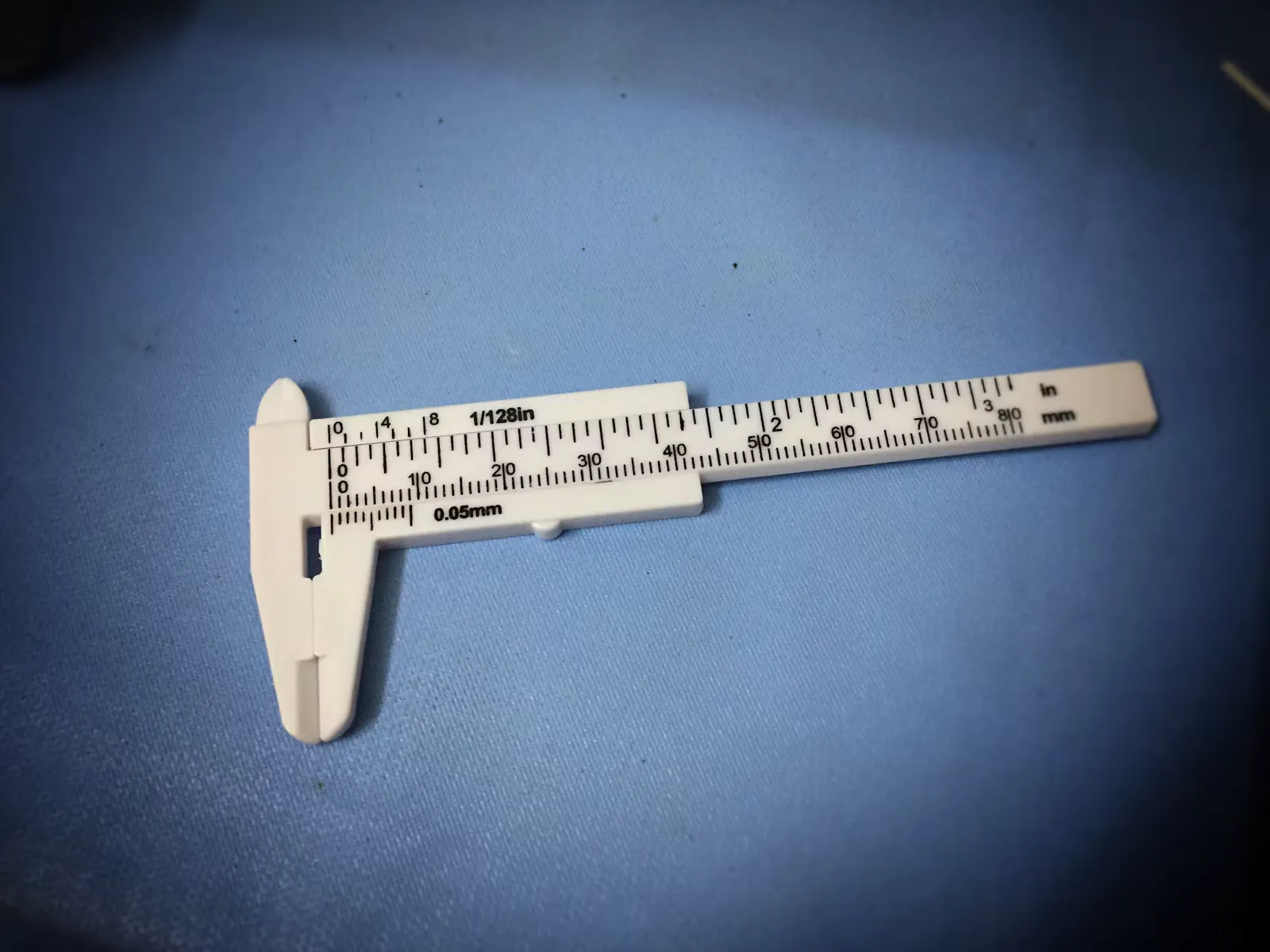
NCERT's exercises give the numbers to practise on. Exercise 1.6 compares a vernier callipers with 20 divisions on the sliding scale, a screw gauge of pitch 1 mm with 100 circular divisions, and an optical instrument that measures to within a wavelength of light. By our arithmetic the screw gauge reads to 1 mm / 100 = 0.01 mm, and if the vernier's main scale is in millimetres, it reads to 1 mm / 20 = 0.05 mm. The optical instrument wins, because a wavelength of light is far smaller than either.
Exercise 1.8 adds two questions worth answering in your own words before a test. Can a screw gauge of pitch 1.0 mm with 200 circular divisions be made more accurate without limit just by adding divisions? On paper, 200 divisions gives 1.0 mm / 200 = 0.005 mm. And why should 100 readings of a rod's diameter give a more reliable mean than 5? Both test whether you understand what least count can and cannot promise.
What is dimensional analysis used for?
Dimensional analysis is the method of writing a physical quantity in powers of the base quantities, such as [M L T⁻²] for force, and using those powers to test or build equations. It has two NEET uses: checking whether an equation is dimensionally consistent, and deducing how one quantity depends on others. It can't find dimensionless constants.
The dimensions of a quantity are the powers to which the base quantities are raised. In mechanics you only need [M], [L] and [T]. NCERT's examples, plus two our arithmetic adds from units NCERT gives:
| Quantity | SI unit | Dimensional formula |
|---|---|---|
| Volume | m³ | [M⁰ L³ T⁰] |
| Speed or velocity | m s⁻¹ | [M⁰ L T⁻¹] |
| Acceleration | m s⁻² | [M⁰ L T⁻²] |
| Mass density | kg m⁻³ | [M L⁻³ T⁰] |
| Force | N = kg m s⁻² | [M L T⁻²] |
| Energy | J = kg m² s⁻² | [M L² T⁻²] |
| Gravitational constant G (our arithmetic) | N m² kg⁻² | [M⁻¹ L³ T⁻²] |
| Planck constant h (our arithmetic) | J s | [M L² T⁻¹] |
Checking an equation
Only quantities with the same dimensions can be added, subtracted or equated. NCERT calls this the principle of homogeneity. In Example 1.3, ½mv² and mgh both come out as [M L² T⁻²], so the equation is dimensionally correct. In Example 1.4, five formulas for kinetic energy are offered. K = m²v³, K = ma and K = ½mv² + ma are ruled out, but dimensions can't choose between ½mv² and (3/16)mv². Only the definition can.
That is the most important sentence in the chapter: a dimensionally wrong equation must be wrong, but a dimensionally correct one need not be right. The arguments of sine, log and exponential functions must also be dimensionless, which is a quick way to spot an impossible option.
Deriving a relation
Example 1.5 is the one derivation in the chapter. Suppose a pendulum's period T depends on its length l, the bob's mass m and g. Write T = k lˣ gʸ mᶻ. Matching dimensions gives x + y = 0, -2y = 1 and z = 0, so x = ½, y = -½ and T = k√(l/g). The mass drops out. The method can't give k; the full theory gives k = 2π.
The method has limits NCERT states plainly. It works with up to three independent quantities, it can't give the number in front, and it can't tell apart quantities with the same dimensions. If laws of motion feel shaky here, revisit laws of motion for NEET, since force and energy dimensions come straight from F = ma.
Order of magnitude in one line
Order of magnitude is the power of ten closest to a quantity. Write it as a × 10ᵇ, round a to 1 if it is 5 or less and to 10 if it is more, and the power that results is the order. NCERT's pair: the Earth's diameter, 1.28 × 10⁷ m, is of order 10⁷ m; a hydrogen atom, 1.06 × 10⁻¹⁰ m, is of order 10⁻¹⁰ m. The Earth is 17 orders of magnitude larger.
Eight traps in units and measurements questions
Most marks lost in this unit are lost on rules you already know. Check every answer against these eight.
- Counting trailing zeros after a unit change. 4.700 m and 4700 mm are the same measurement with four significant figures.
- Counting the leading zeros. 0.0006032 has four significant figures, not seven.
- Using the multiplication rule for a sum. In addition, count decimal places, not figures: 663.8 g, not 664 g.
- Rounding a 5 the school way. With NCERT's convention, 2.745 becomes 2.74 because 4 is even.
- Rounding too early. Keep one extra digit until the last step.
- Adding absolute errors in a product. Add the relative errors, and multiply by the power for a squared or cubed term.
- Treating a correct dimension as proof. ½mv² and (3/16)mv² have the same dimensions; only one is right.
- Memorising the SI constants. NCERT says the long values are not asked. Spend the time on symbols and dimensional formulas.
A four-day revision plan for units and measurements
The chapter is twelve pages, so four focused hours across a week are enough. Do it in this order, because each day uses the one before.
- Day 1: Sections 1.1 and 1.2. Write the seven base quantities, units and symbols from memory, then solve Exercises 1.1 and 1.2 on unit conversion.
- Day 2: Section 1.3. Make a card for each counting rule, solve Examples 1.1 and 1.2, then Exercises 1.10 to 1.12.
- Day 3: Section 1.3.3 and least count. Redo the 164 ± 3 cm² rectangle without looking, then Exercises 1.6 to 1.8, and practise vernier and screw gauge readings from your lab manual.
- Day 4: Sections 1.4 to 1.6. Build your own dimensional-formula table, solve Examples 1.3 to 1.5 and Exercise 1.13, then a timed set of 20 mixed units and measurements questions at about a minute each.
When the chapter is done, place it in the wider plan. The NEET 2027 chapter-wise weightage guide on futureMBBS helps you decide how much revision time each Physics unit gets, its NEET syllabus overview shows every unit on one page, and the NEET UG 2027 preparation guide sets out the full plan. On our side, keep the NEET Physics formula sheet beside you and use NEET Physics questions for the subject-wide picture.
If units and measurements is where your Physics marks slip, NEETsheet's chapter-wise practice and timed mocks show whether the problem is the rule or the arithmetic, so your next hour goes to the right place. Start at neetsheet.in.
Sources
All links were checked on 13 November 2026.
- National Medical Commission (UGMEB), Syllabus for NEET (UG) 2026, public notice of 22 December 2025 (Physics Unit 1 Physics and Measurement, Unit 2 Kinematics): https://cdnbbsr.s3waas.gov.in/s37bc1ec1d9c3426357e69acd5bf320061/uploads/2026/01/202601081066816297.pdf
- National Testing Agency, Information Bulletin NEET (UG) 2026 (Physics 45 questions and 180 of 720 marks; plus four and minus one marking; 180 minutes; syllabus FAQ "no change"): https://cdnbbsr.s3waas.gov.in/s37bc1ec1d9c3426357e69acd5bf320061/uploads/2026/02/202602231394640855.pdf
- National Testing Agency, NEET (UG) website, checked on 13 November 2026 for any NEET (UG) 2027 notice: https://neet.nta.nic.in/
- National Testing Agency, Examination Calendar, December 2026 cycle onwards (no NEET (UG) 2027 date listed up to April 2027): https://nta.ac.in/Download/Notice/ExamcalendarRevised.pdf
- NCERT, Physics Class 11 Part I, Chapter 1 Units and Measurement, reprint 2026-27 (sections 1.1 to 1.6, Table 1.1, Examples 1.1 to 1.5, Summary, Exercises 1.1 to 1.17): https://ncert.nic.in/textbook/pdf/keph101.pdf
- National Institute of Standards and Technology, "SI Redefinition" (vote of 16 November 2018, in force 20 May 2019, kilogram, kelvin, ampere and mole redefined): https://www.nist.gov/si-redefinition
- Bureau International des Poids et Mesures, SI units: https://www.bipm.org/en/measurement-units
Frequently Asked Questions
Units and measurements is Chapter 1 of NCERT Class 11 Physics Part I, titled "Units and Measurement". It covers the SI system and its seven base units, significant figures and rounding, the rules for combining errors, and dimensions with dimensional analysis. For NEET it is Physics Unit 1, "Physics and Measurement".
For NEET, the important topics in units and measurements are the seven SI base units and their symbols, the rules for counting significant figures, the arithmetic and rounding rules, combining errors through relative error, least count of vernier callipers and screw gauge, dimensional formulas, and checking or deriving equations by dimensional analysis.
Yes, one. NCERT Example 1.5 derives the period of a simple pendulum by dimensional analysis: assuming T depends on length, mass and g, matching dimensions gives T = k√(l/g), with mass dropping out. The constant k cannot come from dimensions; the full theory gives 2π.
Units and measurements is Chapter 1, the first chapter of NCERT Class 11 Physics Part I. In the NMC syllabus for NEET (UG) 2026 it is Unit 1, "Physics and Measurement", which comes before Unit 2, Kinematics. Every later Physics unit builds on it.
Study units and measurements in four steps: learn the seven SI base units and symbols, master the significant-figure counting and rounding rules with NCERT Examples 1.1 and 1.2, practise combining errors and least-count readings, then build a dimensional-formula table and solve Examples 1.3 to 1.5. Finish with a timed question set.