
NEET OMR Sheet: How Your Answers Actually Become Marks
Your NEET OMR sheet is the only record of what you answered — not your question paper, not your rough work, not what you remember marking. NEET (UG) is the National Eligibility cum Entrance Test, India's single entrance exam for MBBS and other medical courses, run by the National Testing Agency (NTA). A machine reads the bubbles you darkened, software matches them against an official answer key, and out comes a score from 720. This guide follows that chain, using only what NTA publishes.
What is a NEET OMR sheet, and who actually reads it?
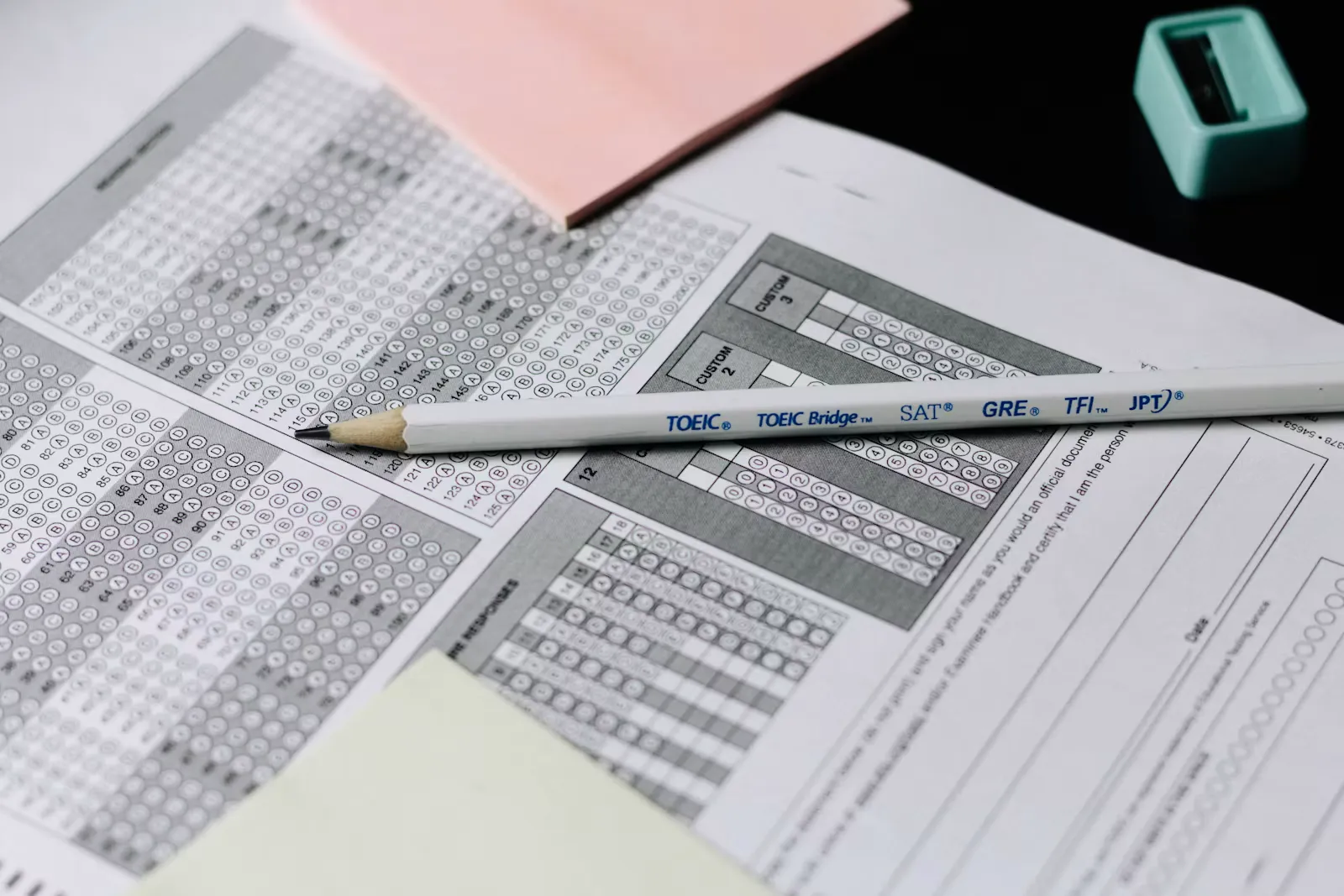
A NEET OMR sheet is the machine-readable answer sheet you fill in the exam hall — a printed grid of bubbles where each row is a question and each bubble an option. Nobody grades it by hand. A scanner photographs the sheet, software decides which bubble in each row is darkened, and that decision becomes your "recorded response".
Because a machine reads marks rather than intentions, a half-darkened bubble or a stray dot in the wrong row can become a data problem weeks later. NTA also treats the paper as evidence: your genuine sheet carries your roll number, test booklet number, an answer-sheet barcode and serial, your handwriting and thumb impression, and two invigilators' signatures.
You do get to see it. After the exam, NTA uploads every candidate's scanned NEET OMR sheet plus the machine-recorded responses on neet.nta.nic.in. In 2026 a copy also went to each candidate's registered email. The exam-hall side of this sits in our guide to NEET exam centres.
How do +4, −1 and 0 turn 180 questions into 720 marks?
The paper is 180 compulsory multiple-choice questions in 180 minutes, each worth four marks. A correct answer earns +4, a wrong option costs −1, a blank earns 0. That is the entire scoring rule; the NEET exam pattern covers the subject split.
| Subject | Questions | Marks | Correct | Incorrect | Blank |
|---|---|---|---|---|---|
| Physics | 45 | 180 | +4 | −1 | 0 |
| Chemistry | 45 | 180 | +4 | −1 | 0 |
| Biology (Botany & Zoology) | 90 | 360 | +4 | −1 | 0 |
| Total | 180 | 720 | — | — | — |
Three exceptions sit in the bulletin. If more than one option turns out correct, +4 goes to everyone who marked any correct option. If all options are correct, +4 goes to everyone who attempted. If no option is correct, or the question is dropped, +4 goes to every candidate who appeared — attempted or not.
Why does a five-mark swing matter on a NEET OMR sheet? Because near the top, marks are packed painfully tight.
When does NTA show you your NEET OMR sheet?
Not on a date you can plan around. The bulletin only promises that the exact date "shall be communicated after the examination on the NTA website", so any calendar circulating before that notice is guesswork. What you can learn is the sequence.
In 2026 the re-examination was held on 21 June. Provisional answer keys went up on 25 June, with a challenge window closing 28 June. Scanned NEET OMR sheet images and recorded responses appeared on 13 July, with a response window closing 15 July. The result came on 16 July.
One 2026 change matters: NTA opened the answer key challenge the moment it published the provisional keys, while scanning was still running, so expert review could run in parallel. If that stays, the key window will keep arriving before you have seen your own NEET OMR sheet.
What can you challenge, and what does each challenge cost?
Two different things, in two different windows, at ₹200 each.
| Answer key challenge | Recorded response challenge | |
|---|---|---|
| Object to | NTA's published answer | What the scanner read off your sheet |
| Affects | Everyone, if accepted | Only you |
| Fee | ₹200 per question | ₹200 per response or field |
| 2026 window | 25–28 June | 13–15 July |
| Decided by | Subject experts | NTA, against the actual record |
An answer key challenge is an academic argument: you think the notified answer to question 47 is wrong. It must be raised under your own question paper series code — printed on the test booklet you carried home — and never needs re-filing under the other sets.
A recorded response challenge is a data argument: you marked option 3 and the machine recorded option 2. It also covers a misread roll number, booklet number or set code. NTA verifies the claim "from the actual record", which is why your scanned NEET OMR sheet appears beside the recorded responses. Compare them row by row.

Why does one accepted challenge change everyone's marks?
Because the answer key is one document, not a per-candidate one. The bulletin puts it plainly: if a challenge is found correct, "the Answer Key will be revised and applied in the response of all the candidates accordingly", and the result is prepared on that revised final key.
So a successful challenge is never a private win. Your raw score can rise while your rank barely moves, because thousands of candidates moved with you. Nobody is told whether their own challenge was accepted, so file one when you genuinely believe a key is wrong — not as a ₹200 lottery ticket.
Is the ₹200 challenge fee refundable?
Here the documents disagree. The 2026 Information Bulletin calls it a "non-refundable processing fee of ₹200/-" for both processes. NTA's notices that year were more generous.
The notice of 25 June 2026 says the ₹200 per question "will be refunded in full for every challenge that is accepted by the expert panel". The annexure to the 13 July 2026 notice says the response fee "is refundable if the candidate's claim is verified as correct and it is established that the scanning agency read the parameters erroneously". Either way, a rejected challenge costs you the money.
Where a bulletin and a live notice conflict, the notice for that cycle governs. Read it in full for the cycle you actually sit, and do not carry a refund assumption from this article into 2027.
Can you ask for a re-check or re-evaluation instead?
No. The bulletin closes that door in one line: "There is no provision for re-checking/re-evaluation of the answer sheets." Its reasons: the sheets are graded by software applied identically to everyone, and candidates already get the two windows above. No correspondence on the subject will be entertained.
That is why the windows matter so much. They are the whole process for disputing a mark. Once they close, your NEET OMR sheet and its recorded responses are final, and the bulletin limits even legal questions to 30 days from the result, in the courts at Delhi.
What happens if two candidates score the same?
Identical totals are common at this scale, so NEET publishes a tie-breaking order. The bulletin calls it the inter-se-merit, and it runs down this list:
- Higher marks or percentile in Biology (Botany & Zoology).
- Then higher marks or percentile in Chemistry.
- Then higher marks or percentile in Physics.
- Then a lower ratio of incorrect to correct answers across all subjects.
- Then that same ratio in Biology, then Chemistry, then Physics.
- If the tie survives, a random process guided by an independent expert committee.
Read step 4 twice, because it changes how you treat the last ten minutes of the paper. Two candidates on the same total, with the same subject scores, are separated by who guessed less. Wild guessing risks minus marks and quietly costs you the tie-break too.
Why a doctored OMR image can end a career before it starts
Every cycle, images of "corrected" OMR sheets circulate online as proof that somebody's result was wrong. NTA's statement of 20 July 2026 addressed this. In the cases it examined, the genuine sheet was on record and matched the declared score; the circulated images were "digitally manipulated versions of the candidates' own genuine OMR answer sheets".
The bulletin already lists this as unfair means — "making fake claims by manipulating the responses in the OMR sheet by/on tampering it in any way whatsoever". The penalties are real: debarment for up to three years from NTA exams, cancellation of the result, and liability under the Public Examinations (Prevention of Unfair Means) Act, 2024. Forging a NEET OMR sheet is a cognisable offence under that Act, and also attracts liability under the Bharatiya Nyaya Sanhita, 2023 and the Information Technology Act, 2000.
Your NEET OMR sheet after the result: a 90-day clock
Download everything the week your result lands. NTA keeps the scanned copy of your original NEET OMR sheet and score card in DigiLocker, the government document platform, if you consented while applying — so digilocker.gov.in is a second place to look if you lose your login.
There is a deadline on the rest. Under the bulletin's weeding-out rules, all records of the cycle are preserved only up to 90 days from the declaration of result, then destroyed. If the result was not what you hoped, our guide to planning a dropper year works through the decision.
What should you do the day your NEET OMR sheet appears?
Treat it as a proofreading job with a deadline, not a results announcement. In order:
- Log in the same day. Keep your application number and password ready, and expect a one-time password on your registered mobile and email.
- Check the identity fields first — roll number, booklet number, set code. A misread here is a data error you can challenge.
- Compare all 180 rows against the recorded responses, not only the questions you remember.
- Note every mismatch with its question number before paying, so you file one clean submission.
- Pay inside the window, then download the acknowledgement page — your only proof the challenge was filed.
- Save the scanned image, the responses and the score card as files. You have 90 days.
Preparing for the next attempt? NEETsheet is our NEET UG preparation app — NCERT-aligned question banks, full-length mocks and revision tracking, built for Class 11, Class 12 and droppers. Try it here and find where your marks leak, before the next NEET OMR sheet is in front of you.
Sources
- National Testing Agency — Information Bulletin, NEET (UG) 2026, 23 February 2026 (Chapters 4, 8, 14, 15 and 16): https://cdnbbsr.s3waas.gov.in/s37bc1ec1d9c3426357e69acd5bf320061/uploads/2026/02/202602231394640855.pdf
- National Testing Agency — Public Notice, Challenge of Provisional Answer Key, 25 June 2026: https://cdnbbsr.s3waas.gov.in/s37bc1ec1d9c3426357e69acd5bf320061/uploads/2026/06/202606251138469985.pdf
- National Testing Agency — Public Notice, Display of Scanned Images of OMR Answer Sheet and Recorded Response, 13 July 2026: https://cdnbbsr.s3waas.gov.in/s37bc1ec1d9c3426357e69acd5bf320061/uploads/2026/07/20260713497007800.pdf
- National Testing Agency — Press Release, NEET (UG) 2026 result, 16 July 2026: https://cdnbbsr.s3waas.gov.in/s37bc1ec1d9c3426357e69acd5bf320061/uploads/2026/07/20260716477215762.pdf
- National Testing Agency — Statement on OMR claims circulated on social media, 20 July 2026: https://cdnbbsr.s3waas.gov.in/s37bc1ec1d9c3426357e69acd5bf320061/uploads/2026/07/20260720623209264.pdf
- National Testing Agency — NEET (UG) portal: https://neet.nta.nic.in/
- National Testing Agency — website: https://www.nta.ac.in/
- DigiLocker, Ministry of Electronics and Information Technology: https://www.digilocker.gov.in/
Frequently Asked Questions
On the official portal, neet.nta.nic.in, once NTA publishes the display notice for your cycle. You log in with your application number and password and clear a one-time password check. In 2026 a copy also went to the registered email address.
If the exam is held on computers there is no paper answer sheet, so the recorded response becomes a digital log rather than a scan. The switch for 2027 was announced by the Union Education Minister, but NTA has published no 2027 notification yet. Our guide to preparing for a computer-based NEET covers what would change.
Only if the expert panel accepts it, and even then not necessarily. A revised answer applies to every candidate across all four question paper sets, so your marks and thousands of others move together. Your total can rise while your rank stays put.
No. The 2026 Information Bulletin states there is no provision for re-checking or re-evaluation, because the sheets are machine graded by identical software and candidates already get two challenge windows.
Ninety days from the date the result is declared. The bulletin's weeding-out rules say all records of the cycle are preserved only up to that point, after which they are destroyed.
Raise it in the recorded response window, online only, at ₹200 per response or data field challenged. NTA verifies the claim against the actual record. Under the annexure to the 13 July 2026 notice, that fee is refundable if the scanning agency is found to have read the sheet wrongly.