
Electrochemistry for NEET: Unit 7 Cells, Formulas and Traps
Electrochemistry is the study of how chemical reactions produce electricity and how electricity drives reactions that would not happen on their own. In NEET it is the second half of Chemistry Unit 7, "Redox Reactions and Electrochemistry", and it is still in the syllabus. This guide shows exactly what that unit asks, with the numbers from your NCERT book and the traps that cost marks.
Is electrochemistry in the NEET 2027 syllabus?
Yes. Electrochemistry is part of Unit 7 of the Chemistry section in the NMC syllabus for NEET (UG) 2026, dated 22 December 2025. No 2027 syllabus exists yet, so this file is the current text. Unit 7 sits in the physical chemistry block, after Equilibrium (Unit 6) and before Chemical Kinetics (Unit 8).
The NEET (UG) 2026 Information Bulletin says in its FAQ that there was no change in the syllabus of NEET (UG) 2026 compared with the previous year. As of 30 October 2026, the NEET (UG) public notices list nothing about the 2027 cycle. A few websites already print 2027 dates, but none of them is NTA. Learn the current wording, and check it again the day NTA releases the 2027 bulletin.
Not sure which chapters were cut and which stayed? Our NEET 2027 deleted syllabus guide goes through the full list. Electrochemistry is not on it.
What does Unit 7 ask you to know?
Unit 7 is one of the more specific units in NEET Chemistry. It names its formulas and devices, so you can turn the wording into a checklist. Here is the official text, unpacked.
| Syllabus phrase (Unit 7) | What it means in practice | What to be able to do |
|---|---|---|
| Electronic concepts of oxidation and reduction, redox reactions, oxidation number, rules for assigning oxidation number, balancing of redox reactions | The Class 11 redox chapter | Find any oxidation number and balance an equation by the oxidation number or half-reaction method |
| Electrolytic and metallic conduction, conductance in electrolytic solutions | Ions carry the current in a solution, electrons in a metal | Use R, G, ρ, κ and the cell constant with the right units |
| Molar conductivities and their variation with concentration: Kohlrausch's law and its applications | Λm rises on dilution, for strong and weak electrolytes in different ways | Add ionic λ° values, find Λ° of a weak acid and its degree of dissociation |
| Electrochemical cells: electrolytic and galvanic cells, different types of electrodes | Cells that make electricity and cells that use it | Name the anode, the cathode, the signs and the direction of electron flow |
| Electrode potentials including standard electrode potential, half-cell and cell reactions, emf of a galvanic cell and its measurement | The E° series and the standard hydrogen electrode | Calculate E°cell and decide which way a reaction runs |
| Nernst equation and its applications | Cell potential away from standard concentration | Calculate E for any concentrations at 298 K and link E°cell to K |
| Relationship between cell potential and Gibbs energy change | ΔG = -nFE | Decide spontaneity and convert between E°, ΔG° and K |
| Dry cell and lead accumulator; Fuel cells | The three named devices | Write the electrode reactions and the job of each part |
Two things are missing from that wording, and both are full sections in the NCERT chapter. Corrosion (NCERT section 2.8) is not mentioned. Faraday's laws are not named either, but NCERT teaches them inside the section on electrolytic cells, which the syllabus does name. So keep Faraday's laws, and read corrosion once for the redox idea without spending a day on it. The mercury cell and the nickel-cadmium cell appear in NCERT but not in Unit 7; they get the same light touch.
Unit 20, on practical chemistry, connects back here. It lists the titrations "oxalic acid vs KMnO4" and "Mohr's salt vs KMnO4", and both are redox titrations. If you can find the oxidation number of manganese in MnO4- (+7, our arithmetic) and see it drop to +2, you already understand why those titrations work. Our d and f block elements guide covers KMnO4 itself.
Redox first: the rules every electrochemistry question uses
Every cell in electrochemistry runs on a redox reaction, so the Class 11 NCERT Redox Reactions chapter is the foundation. It defines oxidation as an increase in oxidation number and reduction as a decrease. An oxidising agent is the reagent that raises another element's oxidation number; a reducing agent lowers it.
The rules for assigning oxidation numbers, in the order NCERT gives them:
- An element in its free state has oxidation number zero (H2, O2, P4, S8, Na).
- A one-atom ion has an oxidation number equal to its charge. Alkali metals are +1 and alkaline earth metals +2 in their compounds; aluminium is +3.
- Oxygen is usually -2, but -1 in peroxides such as H2O2, -1/2 in superoxides such as KO2, and +2 and +1 in OF2 and O2F2.
- Hydrogen is +1, except in binary metal hydrides such as LiH, NaH and CaH2, where it is -1.
- Fluorine is always -1. Chlorine, bromine and iodine are -1 as halide ions but positive in oxoacids and oxoanions.
- The oxidation numbers in a neutral compound add to zero; in an ion they add to the ion's charge.
Try rule 6 on dichromate. Seven oxygens at -2 give -14, the ion carries -2, so two chromium atoms share +12 and each is +6. That one line of arithmetic answers a surprising number of questions.
How do galvanic and electrolytic cells differ?
A galvanic cell turns the energy of a spontaneous redox reaction into electricity; an electrolytic cell uses an outside voltage to force a reaction that would not run by itself. NCERT shows both with one Daniell cell: below an opposing 1.1 V it is galvanic, at exactly 1.1 V nothing flows, and above 1.1 V the reaction runs backwards.
| Feature | Galvanic (voltaic) cell | Electrolytic cell |
|---|---|---|
| Energy change | Chemical energy to electrical energy | Electrical energy to chemical energy |
| Is the reaction spontaneous? | Yes, ΔG is negative | No, it is driven from outside |
| Anode | Oxidation, negative terminal | Oxidation, positive terminal |
| Cathode | Reduction, positive terminal | Reduction, negative terminal |
| NCERT example | Daniell cell, Zn and Cu, 1.1 V | Copper refining, Cu2+ deposited on the cathode |
Notice the one thing that never changes: oxidation always happens at the anode and reduction at the cathode. Only the signs of the terminals swap. A galvanic cell is written with the anode on the left, so the Daniell cell is Zn(s)|Zn2+(aq)||Cu2+(aq)|Cu(s), and E°cell = E°right - E°left.
What comes out of an electrolytic cell? It depends on what is present. Molten NaCl gives sodium and chlorine. Aqueous NaCl gives H2 at the cathode instead, because the H+/H2 couple (0.00 V) beats Na+/Na (-2.71 V), and Cl2 at the anode in spite of oxygen's lower E° (1.23 V against 1.36 V), because of the overpotential of oxygen. NCERT's net reaction gives NaOH, H2 and Cl2.
What do standard electrode potentials tell you?
A standard electrode potential (E°) is the potential of a half-cell measured against the standard hydrogen electrode, with every species at unit concentration and gases at 1 bar. The hydrogen electrode is set at zero at all temperatures. A more positive E° means a stronger oxidising agent; a more negative E° means a stronger reducing agent.
The NCERT Electrochemistry chapter, Class 12 Unit 2 (reprint 2026-27), prints the series in Table 2.1. Eleven of its couples are charted below.
How do you use it? Put the couple with the higher E° as the cathode. For copper (0.34 V) and zinc (-0.76 V), copper is the cathode and E°cell = 0.34 - (-0.76) = 1.10 V. Copper has a positive E°, so H+ ions cannot oxidise it, which is why copper does not dissolve in HCl. Zinc has a negative E°, so it does. That is the whole series in two sentences: higher reduces less, lower reduces more.
A few values from the same table worth knowing by heart: MnO4- to Mn2+ at 1.51 V and Cr2O7 2- to Cr3+ at 1.33 V (the two oxidising agents of Unit 11 and Unit 20), Cl2 at 1.36 V, O2 in acid at 1.23 V, Ag+ at 0.80 V, Fe2+ at -0.44 V and water to H2 and OH- at -0.83 V.
The electrochemistry formula sheet for NEET
These are the relations Unit 7 names, with the conditions that decide whether you can use them. Every formula is from the NCERT chapter linked above.
| Quantity | Formula | Condition or unit trap |
|---|---|---|
| Cell emf | E°cell = E°cathode - E°anode | Use reduction potentials for both; never flip a sign before subtracting |
| Nernst equation | E = E° - (RT/nF) ln Q | n is the electrons transferred in the balanced equation |
| Nernst at 298 K | E = E° - (0.059/n) log Q | Only at 298 K; solids and pure liquids do not enter Q |
| Equilibrium constant | E°cell = (0.059/n) log Kc | At 298 K; at equilibrium E = 0 |
| Gibbs energy | ΔG = -nFE, ΔG° = -nFE°cell | E is intensive; ΔG doubles when you double the equation |
| Link to K | ΔG° = -RT ln K | Same K as in the Nernst form |
| Resistance | R = ρ l / A | ρ in Ω m; 1 Ω m = 100 Ω cm |
| Conductance and conductivity | G = 1/R, κ = 1/ρ, G = κ A / l | κ in S m-1 or S cm-1 |
| Cell constant | G* = l / A = R κ | Found with a KCl solution of known κ |
| Molar conductivity | Λm = κ × 1000 / molarity | Gives S cm2 mol-1 when κ is in S cm-1 |
| Strong electrolyte | Λm = Λ°m - A c^1/2 | Straight line against c^1/2; extrapolate to get Λ°m |
| Kohlrausch's law | Λ°m = ν+ λ°+ + ν- λ°- | Count the ions: CaCl2 has two Cl- |
| Degree of dissociation | α = Λm / Λ°m, Ka = c α² / (1 - α) | Weak electrolytes only |
| Charge passed | Q = I t | I in ampere, t in second, Q in coulomb |
| Mass deposited | m = M I t / (n F) | n is the electrons per ion reduced |
What is F? NCERT uses 96,487 C mol-1 and rounds it to 96,500 for quick work. The exact SI value of the Faraday constant listed by NIST is 96,485.33212 C mol-1. In a NEET option the difference never matters; use whatever the question gives.
How does the Nernst equation work, step by step?
The Nernst equation corrects a cell's standard potential for real concentrations. At 298 K it reads E = E° - (0.059/n) log Q, where Q has products over reactants. Raise the reactant ion, Q falls and E rises; raise the product ion and E falls. NCERT states this for the Daniell cell.
Here it is worked through on our own numbers, so you can check every step:
- Write the cell reaction. Zn(s) + Cu2+(aq) gives Zn2+(aq) + Cu(s). Two electrons move, so n = 2.
- Find E°cell. 0.34 - (-0.76) = 1.10 V from Table 2.1.
- Write Q. Only the ions count: Q = [Zn2+] / [Cu2+]. Take [Zn2+] = 0.1 M and [Cu2+] = 0.001 M, so Q = 100.
- Apply the 298 K form. E = 1.10 - (0.059/2) × log 100 = 1.10 - 0.0295 × 2.
- Finish the arithmetic. E = 1.10 - 0.059 = 1.041 V, about 1.04 V. The cell is weaker because the copper ions it feeds on are scarce.
NCERT's own example runs the same way: a magnesium and silver cell with E° = 3.17 V, [Mg2+] = 0.130 M and [Ag+] = 0.0001 M comes out at 2.96 V. And for the hydrogen electrode at pH 10, the same form gives E = -0.059 × 10 = -0.59 V (our arithmetic for NCERT's intext question 2.4).
At equilibrium the cell is flat, E = 0, so E°cell = (0.059/n) log Kc. For the Daniell cell, NCERT gets log Kc = 37.288 and Kc = 2 × 10^37. For Cu with Ag+ at E° = 0.46 V it gets Kc = 3.92 × 10^15. A cell potential of about one volt means a reaction that runs essentially to completion.
Gibbs energy closes the loop. ΔG° = -nFE°cell, so for the Daniell cell ΔG° = -2 × 96,487 × 1.1 = about -212,271 J, which is -212.27 kJ mol-1. One warning: the intermediate line of NCERT's Example 2.3 prints "-21227 J mol-1", which drops a digit. The kJ figure on the next line is right; trust the arithmetic, not the misprint.
Conductance and Kohlrausch's law in numbers
Conductance in a solution is carried by ions, so it depends on how many ions there are and how fast they move. That is why pure water conducts at only 3.5 × 10^-5 S m-1 while 0.1 M HCl reaches 3.91 S m-1 (NCERT Table 2.2). The strong acid conducts more than 100,000 times better (our arithmetic).
Molar conductivity, Λm, puts every solution on a per-mole basis. It rises as you dilute, because the ions get freer of each other. NCERT's Table 2.3 for KCl at 298.15 K shows it plainly:
| KCl concentration (mol L-1) | Conductivity κ (S cm-1) | Molar conductivity Λm (S cm2 mol-1) |
|---|---|---|
| 1.000 | 0.1113 | 111.3 |
| 0.100 | 0.0129 | 129.0 |
| 0.010 | 0.00141 | 141.0 |
Conductivity κ falls on dilution, while molar conductivity Λm rises. This exact pair of trends is a favourite source of wrong options, so learn it as one sentence: fewer ions per cm3, but each mole of ions works harder.
Kohlrausch's law says the limiting molar conductivity of an electrolyte is the sum of the limiting molar conductivities of its ions. NCERT's Table 2.4 gives those ion values at 298 K.
Two uses of the law, both with Table 2.4 numbers:
- A salt with two anions. For CaCl2, Λ°m = 119.0 + 2 × 76.3 = 271.6 S cm2 mol-1, NCERT's own example. Forgetting the 2 is the classic slip.
- A weak acid you cannot extrapolate. Acetic acid never gives a straight line, so you build its Λ°m from ions: 349.6 + 40.9 = 390.5 S cm2 mol-1 (our arithmetic). Then α = Λm / Λ°m at any concentration, and Ka follows.
How is κ measured? With a Wheatstone bridge fed by alternating current (NCERT gives 550 to 5,000 cycles per second), so the electrodes do not get electrolysed. The bridge itself is the same one our current electricity guide covers in Physics.
Which batteries and fuel cells does NEET name?
Unit 7 names three devices: the dry cell, the lead accumulator and the fuel cell. A battery is a galvanic cell (or several in series) built to be light, compact and steady in voltage. Primary cells run their reaction once; secondary cells can be recharged by pushing current through them in reverse.
| Device | Anode | Cathode and electrolyte | Key numbers in NCERT |
|---|---|---|---|
| Dry cell (Leclanche, primary) | Zinc container: Zn to Zn2+ + 2e- | Graphite rod with MnO2 and carbon; moist NH4Cl and ZnCl2 paste; Mn goes from +4 to +3 | Nearly 1.5 V |
| Lead accumulator (secondary) | Pb + SO4 2- to PbSO4 + 2e- | Grid packed with PbO2; 38% sulphuric acid | Overall Pb + PbO2 + 2H2SO4 to 2PbSO4 + 2H2O on discharge |
| H2 and O2 fuel cell | 2H2 + 4OH- to 4H2O + 4e- | O2 + 2H2O + 4e- to 4OH-; porous carbon electrodes, concentrated NaOH, Pt or Pd catalyst | About 70% efficient against about 40% for thermal plants |
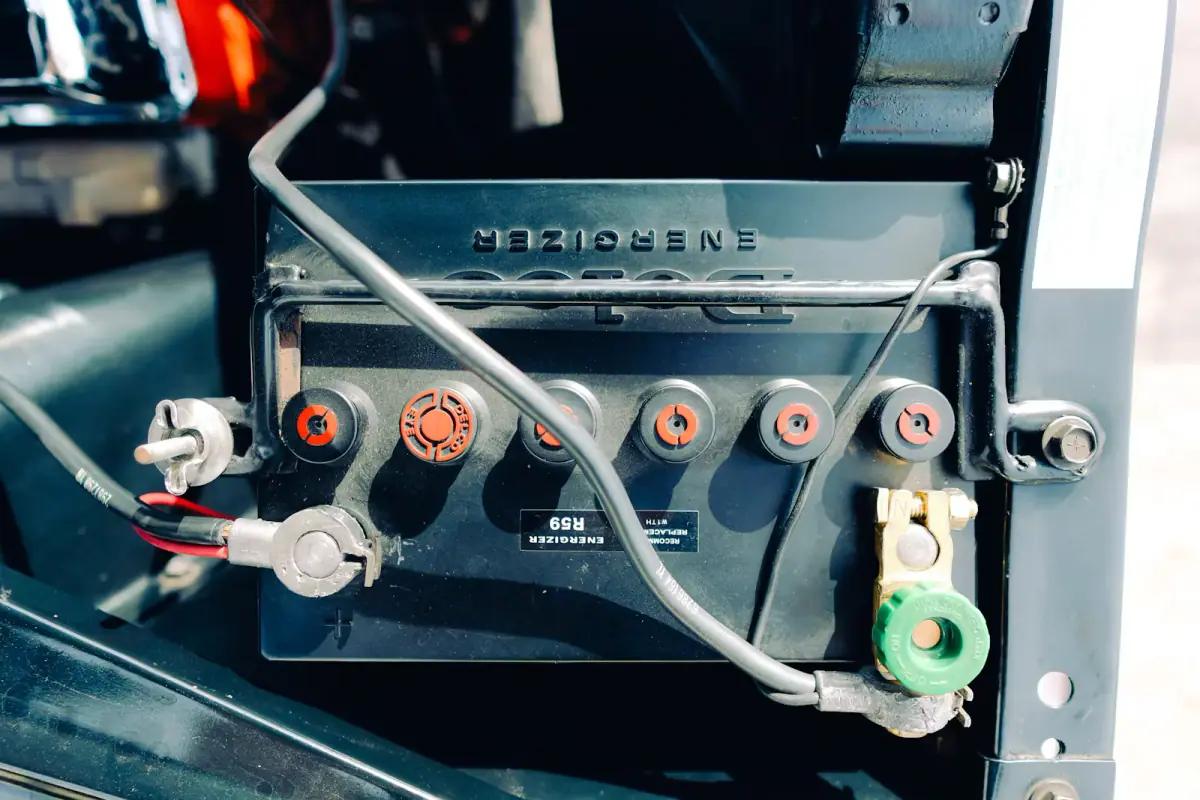
The lead accumulator is the battery in most cars and inverters, like the one in our cover photo. On charging, the PbSO4 on both plates turns back into Pb and PbO2. The fuel cell runs as long as hydrogen and oxygen are fed in; NCERT notes it powered the Apollo space programme and that its water was added to the astronauts' drinking supply.
Which lines trap students in electrochemistry?
Most lost marks in electrochemistry come from a short list. Read it twice.
- Flipping the sign of E° before subtracting. Use E°cathode - E°anode with both as reduction potentials. Subtracting already handles the reversal.
- Multiplying E° when you multiply the equation. E° is intensive and never changes with coefficients. ΔG does change, because n changes.
- Calling the anode negative in every cell. It is negative in a galvanic cell and positive in an electrolytic one. Oxidation at the anode is the only fixed rule.
- Putting solids into Q. Zn(s) and Cu(s) do not appear in the Nernst quotient; only ions and gases do.
- Mixing up κ and Λm on dilution. Conductivity falls, molar conductivity rises.
- Extrapolating a weak electrolyte to get Λ°m. It does not give a straight line. Use Kohlrausch's law.
- Forgetting the 1000 in Λm. With κ in S cm-1 and molarity in mol L-1, Λm = κ × 1000 / molarity in S cm2 mol-1.
- Expecting sodium from aqueous NaCl. Water is reduced instead, so you get H2, Cl2 and NaOH.
How should you revise electrochemistry for NEET?
Revising electrochemistry works best in a fixed order, because each step uses the one before. A plan that fits into one normal study week:
- Copy the scope onto one page. Write the Unit 7 lines and the two KMnO4 titrations from Unit 20. That page is everything this topic can ask.
- Drill oxidation numbers. Twenty quick species a day, including Cr2O7 2-, MnO4-, H2O2, KO2 and NaH, until the exceptions feel automatic.
- Learn the series as a picture. Sketch the E° chart above from memory: lithium bottom, hydrogen zero, fluorine top, with Zn, Cu and Ag in place.
- Work the formula table with numbers. Do two Nernst problems, one Kc, one ΔG°, one Kohlrausch and one Faraday problem per day, and write the units every time.
- Make a three-row card for the cells. Dry cell, lead accumulator and fuel cell, each with anode, cathode and electrolyte. Turn every trap in this guide into a flashcard; our guide to NEET flashcards shows how.
- Test under time. Do mixed physical chemistry questions and sort wrong answers by trap number. A wrong answer at plus four and minus one costs five marks against a right one, which our NEET negative marking guide explains.
How many electrochemistry questions will NEET 2027 have? Nobody can tell you honestly. NTA publishes the subject-wise pattern, 45 Chemistry questions for 180 marks, not a chapter-wise split. For a view of where Unit 7 sits in a sensible revision order, futureMBBS's NEET 2027 chapter-wise weightage guide is a good next read, and the NEET syllabus overview on futureMBBS puts all three subjects on one page.
Pair this unit with your equilibrium revision, since Ka and K both come back here. For the whole subject plan, start with our NEET 2027 Chemistry preparation strategy, and for practice by unit see the NEET Chemistry questions guide. Our NEET previous year question papers guide shows how to use old papers without burning them, and futureMBBS explains why NEET leans on the NCERT book and sets out how to prepare for NEET from start to finish.
Want to know whether electrochemistry is where your Chemistry marks leak? NEETsheet's chapter-wise Chemistry sets and timed mocks show which trap you keep falling into, so your next revision goes there first. Start at neetsheet.in.
Sources
Every syllabus line and number above comes from these documents, opened and read on 30 October 2026.
- National Medical Commission (UGMEB), Syllabus for NEET (UG) 2026, public notice of 22 December 2025, linked from neet.nta.nic.in (Chemistry Units 6, 7, 8 and 20): https://cdnbbsr.s3waas.gov.in/s37bc1ec1d9c3426357e69acd5bf320061/uploads/2026/01/202601081066816297.pdf
- National Testing Agency, Information Bulletin NEET (UG) 2026 (pattern: Chemistry 45 questions and 180 of 720 marks; plus four and minus one marking; syllabus FAQ stating no change for 2026): https://cdnbbsr.s3waas.gov.in/s37bc1ec1d9c3426357e69acd5bf320061/uploads/2026/02/202602231394640855.pdf
- National Testing Agency, NEET (UG) public notices, checked on 30 October 2026 for any NEET (UG) 2027 notice: https://neet.nta.nic.in/public-notices/
- NCERT, Chemistry Class 12 Part 1, Unit 2 Electrochemistry, reprint 2026-27 (Tables 2.1 to 2.4, Examples 2.1 to 2.3 and 2.10, sections 2.5 to 2.8): https://ncert.nic.in/textbook/pdf/lech102.pdf
- NCERT, Chemistry Class 11 Part 2, Unit 7 Redox Reactions, reprint 2026-27 (rules for oxidation number, definitions of oxidation, reduction and the two agents): https://ncert.nic.in/textbook/pdf/kech201.pdf
- National Institute of Standards and Technology, CODATA value of the Faraday constant, 96,485.33212 C mol-1 (exact): https://physics.nist.gov/cgi-bin/cuu/Value?f
Frequently Asked Questions
Yes. Electrochemistry is part of Chemistry Unit 7, "Redox Reactions and Electrochemistry", in the NMC syllabus for NEET (UG) 2026, the current file. The 2026 bulletin says the syllabus did not change from the previous year, and no 2027 syllabus had been published by 30 October 2026.
Electrochemistry is the study of how chemical reactions make electricity and how electricity drives reactions that would not happen by themselves. A battery is the first kind, a galvanic cell. Refining copper or making sodium from molten salt is the second kind, an electrolytic cell. Both run on redox reactions.
The Nernst equation gives a cell's potential at any concentration: E = E° - (RT/nF) ln Q. At 298 K it becomes E = E° - (0.059/n) log Q, with products over reactants in Q. At equilibrium E is zero, which links E°cell to the equilibrium constant.
Kohlrausch's law states that the limiting molar conductivity of an electrolyte equals the sum of the limiting molar conductivities of its cation and anion, each multiplied by how many of that ion the formula gives. It lets you find Λ°m for a weak electrolyte such as acetic acid, which cannot be extrapolated.
Electrochemistry is Unit 2 of NCERT Class 12 Chemistry Part 1 (reprint 2026-27). The redox half of NEET Unit 7 comes from Unit 7, Redox Reactions, of Class 11 Chemistry Part 2. Read both, because the NEET unit joins them into one.